Cedar vs pine log homes compared for rot, insects, maintenance, appearance, and Southeast humidity. Review cost factors, then request a cedar package estimate.
What cedar vs pine actually changes on a log home
People searching cedar vs pine log homes are usually trying to answer one practical question: which wood will still look sound after years of rain, humidity, insects, and sun? That is the right question. The wrong shortcut is treating “cedar” or “pine” as a complete specification. Species, heartwood content, log profile, wall thickness, joinery, overhangs, and finish all show up in how the house ages.
This guide compares cedar and pine the way a buyer in North Carolina and the nearby Southeast should compare them: cost factors, durability, rot, insects, maintenance, appearance, and climate. It is original planning information, not a price list and not a promise that either species will perform the same on every lot.
One business fact belongs up front. Big Twig cedar log home packages use Moosehead white cedar. This article explains pine because buyers ask about it. It is not an offer of a separate pine-log product. When you are ready to price a package, request a free estimate from current drawings and a written scope.
Cedar vs pine log homes at a glance
Use this as a briefing, then read the sections that match your site. A shaded cove in Western North Carolina is not the same exposure as an open ridge, a lakeside lot, or a Piedmont clearing with afternoon sun.
- Cost: cedar usually costs more as a raw log; diameter, profile, openings, insulation assembly, engineering, and freight often move the package as much as the species name.
- Durability: cedar heartwood is the more naturally durable exterior log; pine depends more on detailing and finish.
- Rot: cedar extractives discourage decay fungi; pine is more vulnerable where logs stay wet, splash, or meet soil.
- Insects: cedar is the more insect-resistant choice against termites and carpenter ants; pine needs a tighter moisture-and-finish plan.
- Maintenance: both need water management; pine typically needs more attentive staining. Big Twig’s published restain planning range is every three to five years, sooner on harsh elevations.
- Appearance: cedar reads warmer (amber, red, brown); pine reads lighter, with a bolder grain and more visible knots.
- Southeast / NC climate: humidity, wind-driven rain, and insect pressure make natural resistance more valuable than it is in a dry, cold climate.
Cost factors: why quotes differ more than species names
Cedar typically commands a premium because the tree grows more slowly and graded, dry, usable log stock is tighter to source. Pine is abundant in the South, which is why it has been a workhorse building wood for generations. That supply story is real. It still does not tell you what your package will cost.
Big Twig does not advertise a universal square-foot price, a cedar surcharge, or a pine discount. Material prices move, and two homes with similar floor area can need very different logs, openings, roof geometry, and engineering. Compare current, itemized quotes for the same species, grade, dimensions, and package scope. An old percentage comparison cannot establish the cost of your order.
The cost factors that actually belong on the worksheet are the same ones that shape any custom material package: species and grade, including heartwood versus sapwood; log diameter, profile, and corners; whether the wall is full log, half-log, or a hybrid mix of log and conventional framing; windows, doors, and walls of glass; insulation assembly, roof system, stairs, and railings; the finish system; engineering, freight, and delivery access; and the builder’s construction budget, which is separate from the material package Big Twig supplies.
Lifetime cost is a second ledger. A less expensive pine package can still cost more to own if the finish fails, splash wets the sills, or insect damage has to be repaired. Cedar’s natural resistance can reduce that risk. It does not erase the need to keep water off the wall. Ask for matching inclusions before you decide that either species is “cheaper.”
Durability: heartwood, moisture, and how a wall stays sound
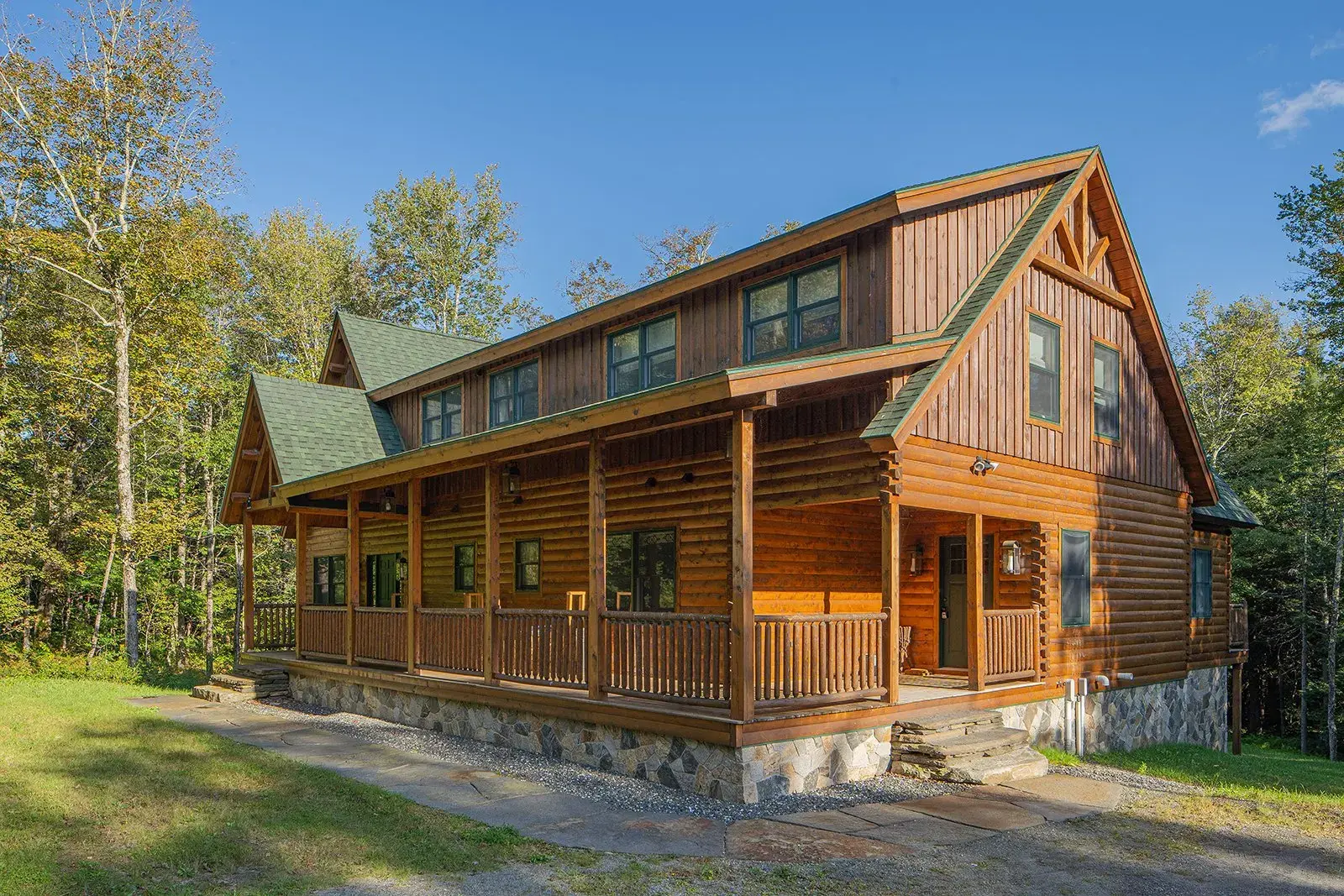
Durability is not a contest between two marketing words. It is a contest between wood chemistry and water. Cedar heartwood contains natural extractives that discourage the fungi and insects that break wood down. That is why cedar has a long record in siding, shingles, and outdoor millwork—not only in log walls. Pine can be structurally excellent, which is why so much framing lumber is pine, but an exposed log is not a stud hidden behind housewrap.
Sapwood of either species is less durable than heartwood. A quote that only says “cedar” or “pine” without grade, moisture content, and how the logs are milled leaves the important part unsaid. Ask what you are actually buying: species, grade, heartwood expectation, and how the logs will be protected between mill, truck, and job site.
Geometry matters as much as species. Wide eaves, a foundation that keeps the first course above splash, capillary breaks at sills, and flashing at windows do more for long-term soundness than arguing about a small difference in density. Cedar is more forgiving when a detail is imperfect. It is not a license to bury a log in mulch.
Rot resistance in humid weather
Rot is a living process. Decay fungi need moisture, oxygen, and a food source. Keep the log dry enough, and even a less durable species can last. Keep it wet, and even cedar will eventually lose. The Southeast makes that physics harder because humidity stays high, summer storms are frequent, and mountain coves can hold fog and shade against a wall for days.
Cedar’s advantage is that its extractives make the food source less appealing. Heartwood is the part that earns the reputation. End grain at corners, log ends, and poorly flashed openings is still a wet-wood problem. Pine absorbs water more readily and gives fungi an easier foothold, especially at the sill, splash zone, and any place soil or vegetation holds moisture against the wall.
The repair that owners remember is rarely a whole wall. It is a localized failure: a sill log that stayed wet, a window buck that leaked, a downspout that dumped onto a corner. Species choice lowers the odds. Detailing and drainage decide whether those odds ever become a project. If you are comparing packages, ask how the first course is held off grade and how roof water is taken away from the logs.
Insect resistance: termites, carpenter ants, and exposed logs
Termite pressure is a fact of life across much of North Carolina, South Carolina, Tennessee, and Georgia. Carpenter ants follow moisture and decay. Cedar’s natural oils help repel both, which is one reason it is the more common choice for an exposed log exterior in this region. Pine is more inviting when it is damp, in contact with soil, or already starting to soften.
Natural resistance is not a pest-control contract. It does not replace a soil treatment, a termite shield where the design calls for one, or a habit of looking for mud tubes, frass, and woodpecker activity. Cedar still needs those checks; pine needs them sooner and more often if the wall stays wet.
The practical comparison is about where insects get their first chance. Keep vegetation off the wall. Keep firewood away from sills. Keep gutters open so overflow does not soak the lower courses. Species is the starting resistance. Site habits are the rest of the system. If a log home will sit empty as a second home, those inspections matter even more because a small colony can work for months before anyone notices.
Maintenance: stain, water, and what you can skip
Owners often ask whether pine has to be stained every year and whether cedar can be ignored. Neither extreme is a good plan. The stain’s job is to slow UV damage and shed water. When water stops beading, the finish is doing less than it should. Big Twig’s log-home maintenance guidance uses a restain planning range of every three to five years, with south and west walls checked first because they take the harshest sun. Follow the stain manufacturer’s instructions for the logs in your package.
Pine typically needs more attentive finish care because it is more porous and less naturally durable. Miss a cycle on a harsh elevation and moisture has an easier path in. Cedar is more forgiving if you fall behind, and it can be left to weather to a silver-gray patina if that is the look you want. Forgiving is not the same as finish-free. Unfinished cedar in Southeast humidity still needs overhangs, flashing, and a wall that can dry.
The maintenance that costs the least is also the work people skip: clean gutters, keep downspouts discharging away from the sill, keep mulch and soil off the first course, and walk the chinking and openings in spring and fall. Those habits protect both species. They matter more on pine because the wood has less chemistry standing behind a missed season. Plan the ladder work when you plan the house—especially on a tall gable that faces west.
Appearance: color, grain, and how the wood ages
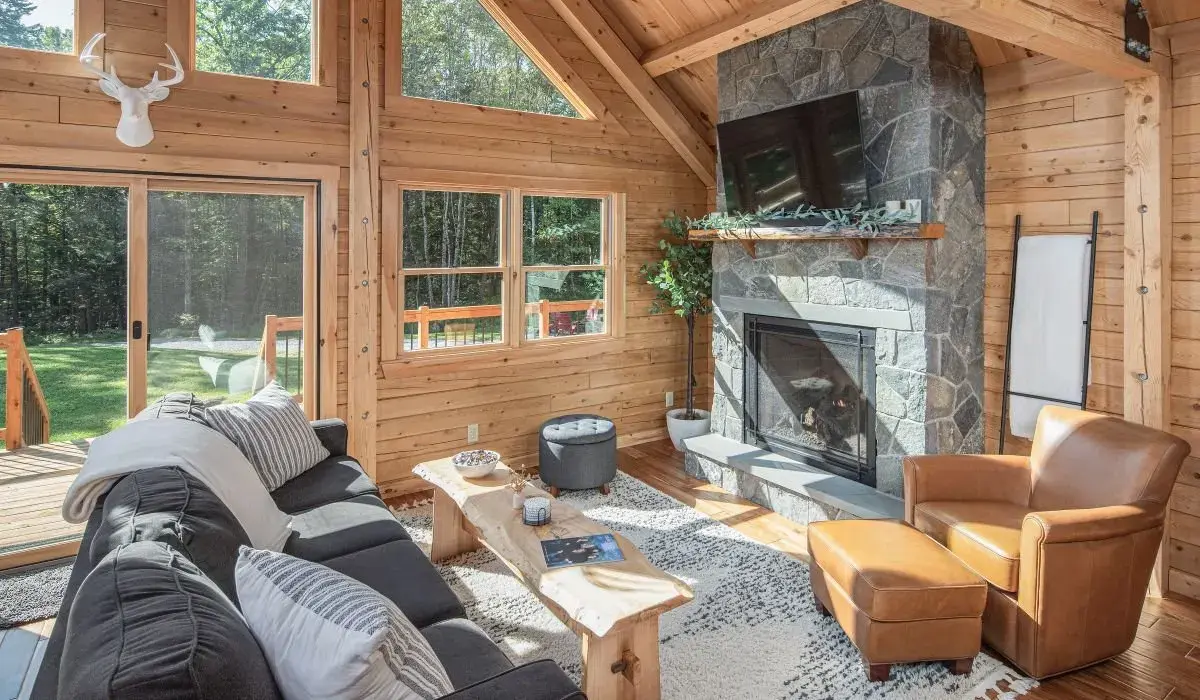
Fresh cedar usually reads warmer: amber, red, and brown, with a finer grain that takes a translucent stain well. Fresh pine is lighter and blonder, with a more pronounced grain and more visible knots. Neither look is “more authentic.” Both are log homes. The question is which character you want in afternoon light and which you still want after the first few summers.
Left unfinished, both species can gray. Cedar tends to weather more evenly. Pine can gray in blotches where sun, splash, and retained moisture differ from one elevation to the next. Stain can bring them closer together, which is why a photograph is a poor substitute for a sample. Look at the actual profile and finish on a sample, not only at a whole-house picture from another climate.
Inside the house the species is quieter. Interior logs, paneling, and trim are sheltered from UV and rain, so color is more about the finish you choose than about which tree grew in which forest. If the great room is the reason you want a log home, spend time on profile and finish samples. If the exterior is what you see from the ridge, spend that time on how the wall will look wet, dry, and five years on.
Climate in the Southeast and North Carolina
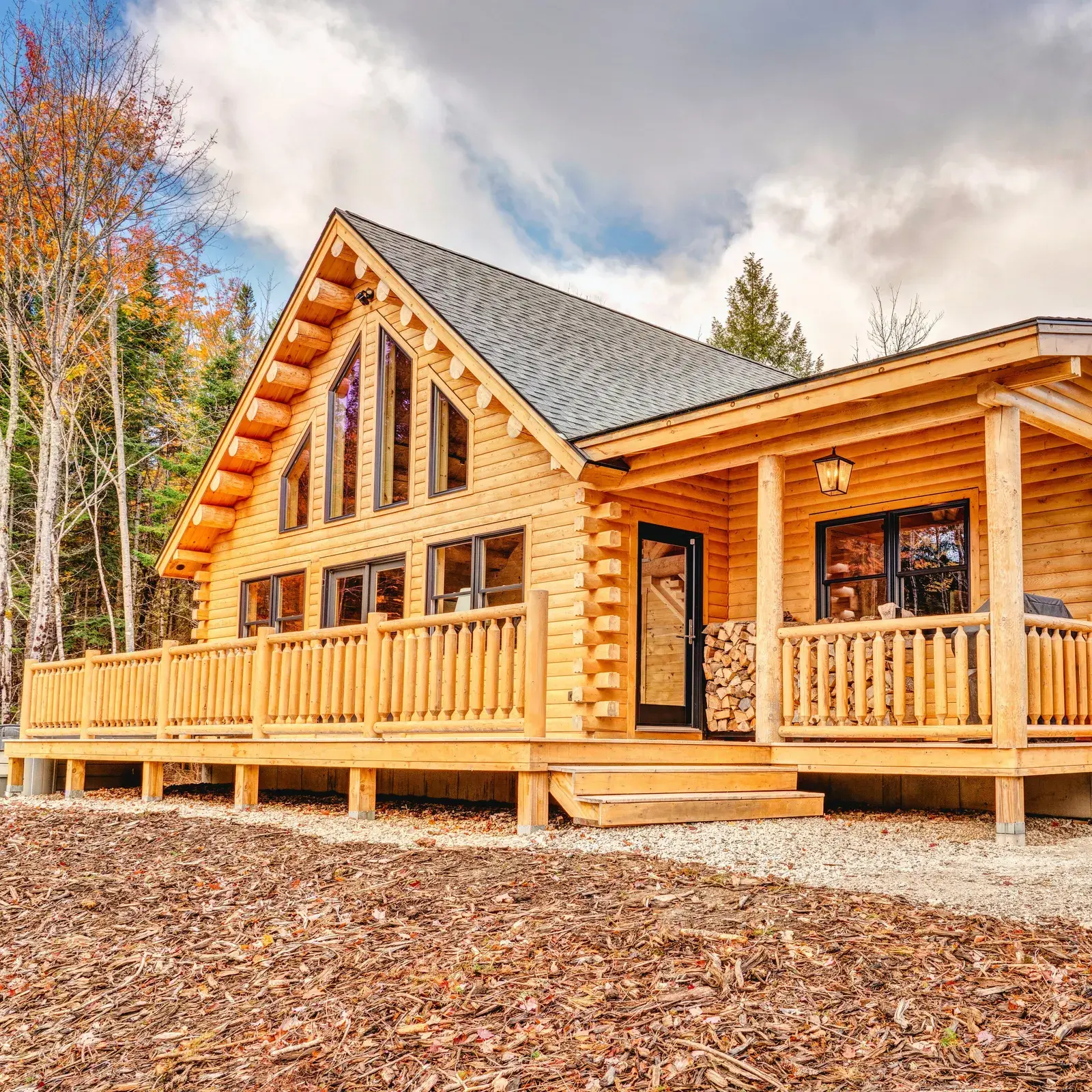
A cedar vs pine comparison written for a cold, dry climate undersells what North Carolina asks of a log wall. Western North Carolina combines mountain UV, freeze-thaw at elevation, and long stretches of humidity. The Piedmont adds heat. Coastal and lower-elevation sites in the Carolinas and Georgia add even more insect pressure. None of those conditions make log homes a bad idea. They do make moisture detailing non-negotiable.
Wind-driven rain on a west or south gable, a roof that dumps onto a porch beam, and a grade that slopes toward the wall are the local failure patterns. Cedar’s rot and insect resistance is most valuable exactly where the wall cannot dry quickly: shaded coves, lakesides, and densely wooded lots. Pine can still be specified in this climate, but the design has to work harder—deeper overhangs, stricter clearance at grade, and a finish schedule someone will actually keep.
Microclimate beats a state line. Two lots in the same North Carolina county can treat wood differently if one sits on a breeze-swept ridge and the other sits in a hollow. Share the site, the tree cover, and the elevation with Big Twig and with the builder you hire. The species conversation should follow the lot, not the other way around.
Insulation, log profile, and what species will not decide
Buyers sometimes hope one species will “insulate better.” The difference in insulating value per inch between cedar and pine is small next to wall thickness, profile, joinery, and how the openings are sealed. Pine is generally a bit denser; cedar is generally a bit more stable as it dries. Neither fact should overrule a wet-wall problem or a package that does not match the design.
Moosehead cedar packages can be discussed with different profiles and insulation approaches. Confirm what is in the quote: the log face, any insulation assembly, the roof, and the air-sealing plan. Chinking, splines, and window installation do more for comfort than splitting hairs on species R-value. If energy performance is a primary goal, talk through the whole envelope with your design team rather than using cedar vs pine as a proxy for an energy model.
How to choose—and what Big Twig actually supplies
Choose cedar when the lot is humid, wooded, or hard to keep dry; when you want a warmer color and a more forgiving maintenance margin; and when the quote can carry the material premium. Choose pine only when you understand that it is a different product with a tighter finish-and-detailing burden—and when the supplier in front of you actually sells it. Big Twig does not.
Big Twig supplies Moosehead cedar log and hybrid packages, alongside EPS SIP home and EPS building packages. Hybrid packages use log or timber where you want the character and conventional framing where it makes sense; they are not a pine-log substitute. Discuss species, profile, finish, and maintenance expectations against the actual drawings. Your builder manages construction, permits, and the completion schedule.
Bring a plan, a site description, and the questions from this article. Explore cedar log home packages or request a free estimate. Call (833) 244-8944 to talk through the materials that belong in the quote for your North Carolina, South Carolina, Tennessee, or Georgia site.
Cedar vs pine log homes: questions we hear
Which is better for cedar vs pine log homes in North Carolina?
For most North Carolina and Southeast sites, cedar is the more forgiving exterior log because its heartwood resists rot and insects better in humidity. Pine can still make a sound log home when it is detailed to stay dry and kept on a finish schedule. Big Twig supplies Moosehead cedar log packages; compare the actual species, grade, and profile on a current quote rather than treating either word as a guarantee. Start with cedar log home packages or request a free estimate.
Does cedar resist rot and insects better than pine?
Yes, in general. Cedar heartwood contains natural extractives that discourage decay fungi, termites, and carpenter ants. Pine is more vulnerable when it stays wet or sits near soil. Neither species is maintenance-free: keep logs off grade, move roof water away from walls, and follow the finish instructions for the product you actually buy.
How much more does a cedar log home cost than pine?
Big Twig does not publish a universal square-foot price or a cedar-versus-pine surcharge. Cedar usually costs more as a material because it grows more slowly and is graded more tightly, but log diameter, profile, openings, insulation assembly, engineering, and freight often move a package more than the species name. Compare current, itemized quotes with matching scope.
How often do cedar and pine log homes need staining?
Plan exterior stain around exposure, not a calendar slogan. Big Twig’s log-home maintenance guidance uses a restain range of every three to five years, or sooner on sun-baked south and west walls when water stops beading. Pine typically needs more attentive finish care because it is less naturally durable. Always follow the stain manufacturer’s instructions for the logs in your package.
Can cedar log homes be left unfinished in the Southeast?
Cedar can weather to a silver-gray patina, and some owners prefer that look. Humidity, wind-driven rain, and strong sun in North Carolina still argue for overhangs, flashing, and a plan for water. An unfinished wall is a design choice, not a substitute for keeping soil, splash, and gutters off the logs. Confirm finish expectations in your quote.
Does Big Twig Homes sell pine log home packages?
No. This cedar vs pine comparison is educational. Big Twig supplies Moosehead cedar log and hybrid packages, plus EPS SIP home and EPS building packages. Review cedar log home packages, then request a free estimate for the materials that belong on your North Carolina, South Carolina, Tennessee, or Georgia site.
Big Twig Homes Team
The Big Twig Homes team prepares practical planning information for cedar log, hybrid, EPS SIP home, and EPS building material packages. Product and technical references are identified where applicable; your current quote and project professionals control the scope for your project.
Read our editorial standards