
Smart thermostats, security cameras, and lighting control work beautifully in log homes -- you just need to plan for the thick walls. Here are our top picks.
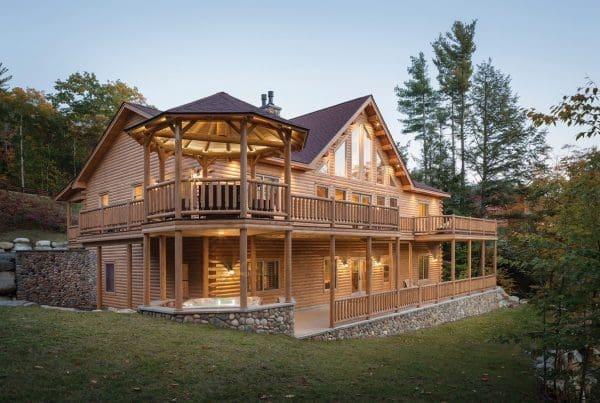
Smart Home Meets Thick Log Walls
There's a persistent rumor out there that smart home tech doesn't work in log homes. It comes from a real place — the plugs, the connectivity, the placement of sensors all behave differently when your walls are a foot of solid wood instead of hollow framing. But the truth is, a log home can be every bit as smart as any house in town. You just have to plan for the walls.
The two big challenges are wireless signal loss through logs and the lack of easy wall cavities for running low-voltage wire. Neither is a dealbreaker. Both are solved with a little forethought, which is exactly what a good builder adds to the equation.
Fix the Backbone First: Wi-Fi
Before you buy a single smart appliance, solve the connectivity problem. Solid logs and heavy timber are surprisingly good at blocking 2.4 GHz and 5 GHz signals, so a single router in the living room won't reach the end of a long great room or the upstairs loft.
The professional answer is a mesh Wi-Fi system with several nodes, or better yet, a wired access point in each gap you didn't cover. If you put the network planning into the build itself — running a couple of low-voltage drops and planning node locations — you'll never fight dead zones. This is the single most important 'smart device' in the whole house.
Smart Thermostats Slash the Heating Bill
A smart thermostat is the highest-impact gadget you can add to a mountain home by far. The biggest cause of wasted energy in a log home is heating rooms nobody's using, and a thermostat that learns your schedule — or that you can control from your phone in Charlotte before you drive up for the weekend — fixes exactly that.
Setback is your friend. Letting the house coast at 55 degrees while you're gone and warming it up an hour before you arrive can cut a mountain heating bill by a meaningful percentage every single season. Throw in the zone control and you'll only heat the loft while you're sleeping upstairs.
Security That Watches the Whole Property
A mountain home is often a second home, which means it sits empty for stretches. Smart security is how you keep eyes on it. Wireless, battery-powered cameras have gotten good enough that the thick-wall challenge barely matters if you place them thoughtfully.
We like a mix: a couple of battery cameras covering the driveway and the approach to the house, and one or two indoor cameras for peace of mind. Add smart door locks, which are genuinely useful for letting in a guest or the fireplace service tech without handing over a key, and you've got a system that makes owning a distant home far less anxious.
Lighting Control Built for the Wood Glow
Smart lighting does more than turn lamps on from a phone — it protects your logs. Because you can schedule lights to come on and off on a pattern, your home looks lived-in while you're away. And smart dimmers let you set that warm ambience that makes cedar and pine look their best, rather than blasting everything at 100%.
In a log home, plan you smart light switches at the build stage. Solid walls mean you want the wiring and boxes run before the finish goes on, and battery-powered smart bulbs are a workable retrofit for lamps but won't handle the big sconces and chandeliers a log great room deserves.
Sensors That Catch a Problem Before It's a Disaster
The least glamorous smart devices are often the most valuable on a mountain property. A smart water-leak detector under the kitchen sink or near the water heater can catch a slow leak that would otherwise soak a log wall for weeks while you're in another state.
Smart smoke and carbon monoxide detectors are essential in a home built around a fireplace or wood stove, and the interconnectivity means a problem in the basement alerts you on your phone from anywhere. For a second home in the mountains, these quiet sensors are the difference between a small repair and a catastrophe.
Plan It in, or Work Around It Later
Plan electrical and smart-home requirements during design with your builder and electrician. Confirm compatible equipment and approved service routes before assembly and finishes; Big Twig supplies the material package rather than electrical installation.
But if you're retrofitting an existing log home, you're far from out of luck. Mesh networking plus battery-driven devices plus a few well-placed hardwired points will get you most of the way. The goal isn't a house full of gadgets — it's a house that's more comfortable, more secure, and cheaper to run, and that you can check on from anywhere.
Big Twig Homes Team
The Big Twig Homes team prepares practical planning information for cedar log, hybrid, EPS SIP home, and EPS building material packages. Product and technical references are identified where applicable; your current quote and project professionals control the scope for your project.
Read our editorial standards