
Cedar's natural cellular structure gives it surprising insulation value. We break down the thermal data and explain why cedar homes stay comfortable year-round.
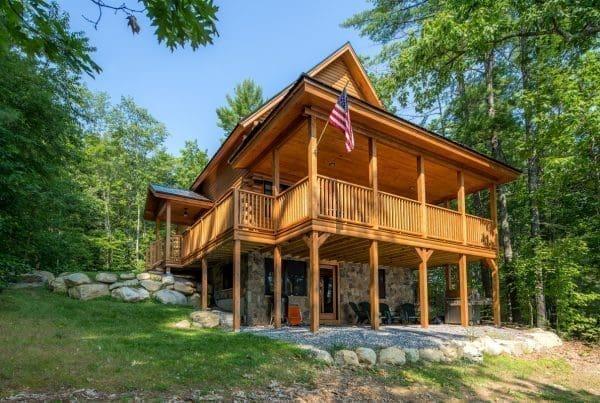
Cedar Is a Comfortable Surprise
If you only looked at the raw insulation numbers, you'd think a log home would be a drafty, uncomfortable place. Cedar's R-value per inch is modest, and solid log walls don't stack up against a stud wall stuffed with fiberglass on paper. Yet walk into a well-built cedar home in the middle of summer or winter and it often feels remarkably steady.
The reason is that a log wall does something a sheet of paper math can't capture: it stores heat. This is the thermal-mass effect, and it's the reason cedar homes punch above their R-value when it comes to comfort.
Thermal Mass Smooths the Swings
A log wall is basically a big slab of mass. During the day it soaks up heat radiating from the sun and the room; through the night it slowly releases that stored warmth. The result is that indoor temperature drifts less. The house holds a steadier, more even temperature across the day instead of following every outside swing.
That matters plenty in the mountains, where you can burn through a 20-degree swing between afternoon and sunrise. A structure with real thermal mass carries you through that swing on its own stored energy.
The Time-Lag Effect
Thermal mass doesn't just store heat — it delays it. That's the time-lag effect, and it's exactly what you want on a hot summer afternoon. The sun blasts the west wall at 3 p.m., but by the time that heat works its way through the mass of the logs and into the room, the sun is down and the air has cooled.
That lag is a big part of why a cedar home can feel naturally comfortable with less air conditioning. The wood is doing the work of smoothing out the day's heat, softening the peaks and valleys.
Where to Insulate a Log Home
Because the log walls carry such useful thermal mass, the best place to focus insulation is where you lose the most energy for the least gain — the roof and ceiling. Heat rises, and a cathedral ceiling over a great room is a huge loss area. Insulate the roof heavily and you'll see more comfort than trying to chase R-value in the logs themselves.
Floors over crawlspaces or unconditioned basements also deserve attention. Between a well-insulated roof and a solid floor, the log walls can do what they're best at: providing steady comfort through mass.
Airtightness Does the Rest
Thermal mass and R-value only take you so far if the envelope leaks. Chinking and corner joints have to seal, windows have to be tight, and the sill has to be snug. An airtight, well-chinked cedar home lets the thermal mass do its steadying work instead of leaking out all its stored comfort.
Blower-door test results on a properly sealed log home are often far better than people expect. When the envelope is tight and the mass is doing its job, the thermal performance of a cedar home genuinely holds its own.
The Comfort Verdict
Judge a log home the way you'll actually live in it — by comfort and bills, not by a per-inch R-value chart. Cedar's thermal mass delivers a steady, even, naturally comfortable home that moderates temperature swings all on its own, especially when paired with a well-insulated roof and a tight envelope.
It's a different kind of efficiency than a pure insulation spec, but for many owners it feels better — and that's the number that actually counts after the keys are in your hand.
Big Twig Homes Team
The Big Twig Homes team prepares practical planning information for cedar log, hybrid, EPS SIP home, and EPS building material packages. Product and technical references are identified where applicable; your current quote and project professionals control the scope for your project.
Read our editorial standards