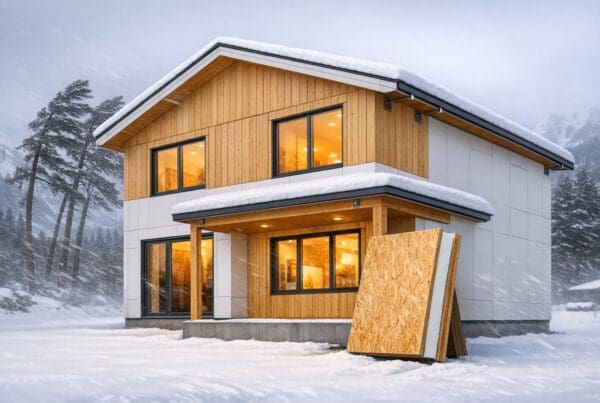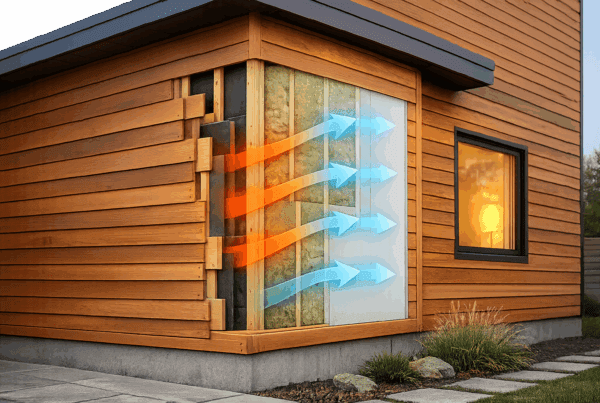


SIP panels (Structural Insulated Panels) are a highly efficient building solution that combines insulation, framing, and sheathing into a single component. These prefabricated panels are made of a rigid foam insulation core sandwiched between oriented strand board (OSB) facings. Here’s why they’re a game-changer for energy-efficient construction:
- Energy Savings: SIPs eliminate thermal bridging and are 15 times more airtight than conventional stick-framed buildings. This reduces heat loss, lowers energy bills, and minimizes carbon emissions.
- Less Waste: Factory precision-cut panels reduce onsite waste and shorten construction timelines by up to 55%.
- Eco-Friendly Materials: OSB facings come from fast-growing, sustainably managed wood, while foam cores like EPS and GPS offer high thermal performance with a lower environmental impact.
SIPs also integrate well with biodegradable materials like straw, mycelium, and hemp, further reducing their carbon footprint. Their airtight design supports smaller HVAC systems and aligns with green building certifications like ENERGY STAR and LEED. Whether you’re building a home or a commercial structure, SIPs offer a practical, efficient, and environmentally conscious solution.
SIP Panels: The Future of Fast & Sustainable Construction | Smarter, Stronger Wall Systems
sbb-itb-1086e16
Environmental Benefits of SIP Panels
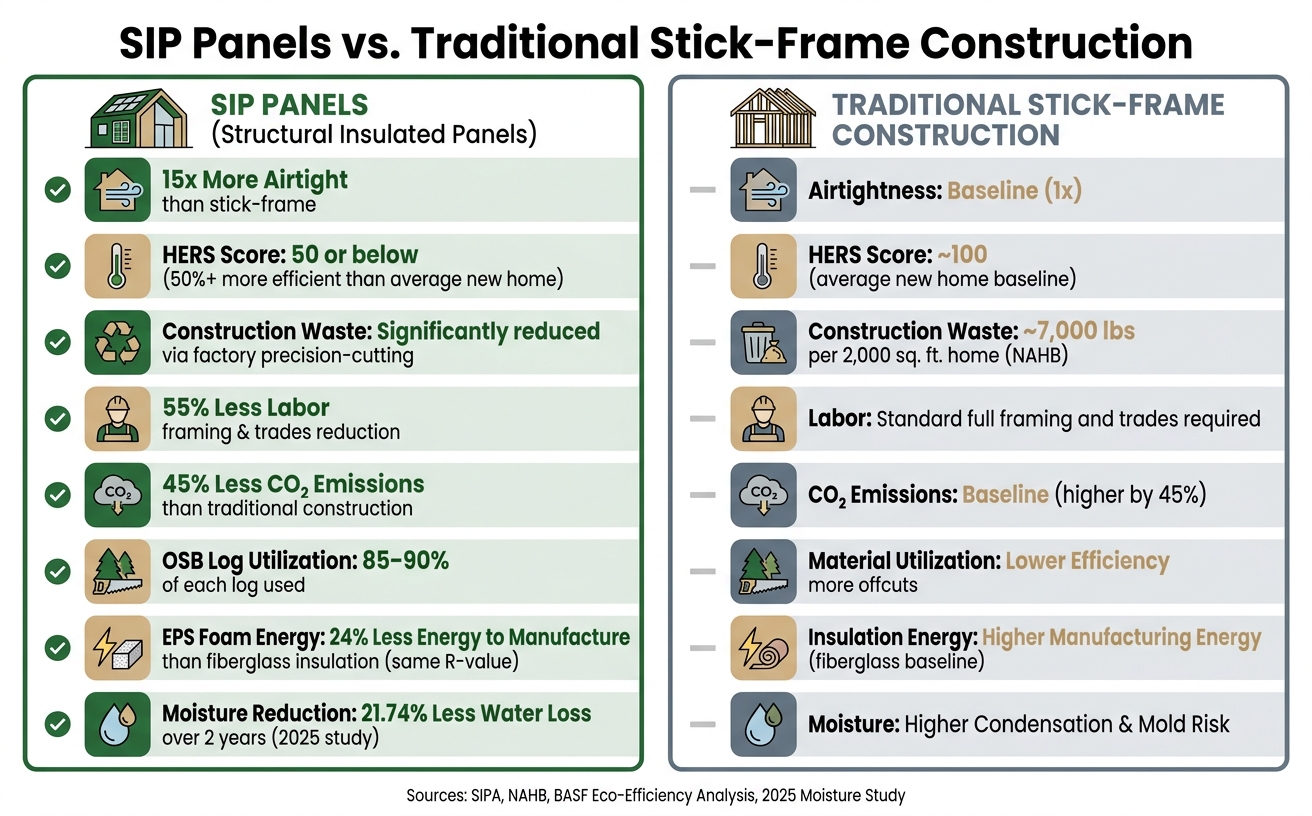
SIP Panels vs. Traditional Stick-Frame Construction: Key Stats
SIP panels bring clear environmental perks, from cutting energy use to reducing construction waste, aligning with sustainable building goals.
Energy Efficiency and Thermal Performance
A standout advantage of SIPs is their ability to lower energy consumption. By offering continuous insulation, SIPs eliminate thermal bridging, which helps reduce heat loss during winter and heat gain in summer.
Blower door tests reveal that SIP buildings are 15 times more airtight than traditional stick-framed homes, often achieving HERS scores of 50 or below [1]. Considering that air leakage can account for up to 40% of a home’s heat loss, this airtightness translates to lower energy bills and reduced carbon emissions.
"Reduced energy consumption for heating and cooling throughout building life is SIPs’ most substantial contribution to preserving the environment." – Structural Insulated Panel Association [1]
Additionally, SIP homes often require smaller HVAC systems, making it essential to have these systems properly sized by a qualified professional [2].
Reduced Construction Waste
Sustainable construction relies on minimizing waste at every stage. According to the National Association of Home Builders (NAHB), building a standard 2,000 sq. ft. home generates about 7,000 lbs. of construction waste [1]. SIPs tackle this issue head-on: panels are precision-cut in factories, reducing the need for onsite cutting and trimming, and significantly lowering lumber waste.
Using SIPs also reduces framing and trades labor by up to 55%, which shortens construction timelines and further decreases onsite waste [2].
Renewable and Eco-Friendly Materials
The materials used in SIPs highlight their contribution to eco-conscious construction. The OSB facings on SIP panels are made from fast-growing, sustainably managed wood species, avoiding reliance on old-growth timber. Impressively, about 85–90% of a log is utilized to produce OSB panels [1].
The foam cores in SIPs also have a relatively low environmental footprint. For instance, EPS foam requires 24% less energy to manufacture compared to fiberglass insulation with the same R-value. GPS (graphite polystyrene) adds graphite particles to the EPS, delivering better thermal resistance in a thinner profile – useful for designs where wall thickness matters. These panels are frequently used in custom cedar log homes to combine rustic aesthetics with modern efficiency.
"Polyurethane and expanded polystyrene SIPs are consistently the more eco-efficient technology. In addition to providing energy efficiency benefits, they have low environmental impact over their life cycle." – BASF Residential Insulation Systems Eco-Efficiency Analysis [1]
Studies show that SIP construction can reduce CO₂ emissions by 45% compared to traditional stick-framed methods [2]. This makes SIP panels a natural fit for projects incorporating biodegradable and bio-based materials.
How SIP Panels Work with Biodegradable and Bio-Based Materials
Bio-Based SIP Designs
The evolution of SIP construction is moving away from petroleum-based foam cores toward using organic, carbon-storing materials. Researchers are exploring options like compressed agricultural straw, mycelium-based insulation, and hemp batts as core materials. These alternatives not only reduce energy use but also actively sequester atmospheric carbon.
For instance, Verdant Structural Engineers (VSE), under the leadership of Anthony Dente, have created 5.5-inch straw-based SIPs capable of storing 74 million kilograms of CO₂ over five years – a figure comparable to the emissions from over 8.3 million gallons of gasoline.
"Straw is composed of atmospheric carbon which has been converted to ‘solid’ stored carbon by photosynthesis… In an S-SIP, straw is protected from decomposition [resulting in] negative carbon emissions." – Anthony Dente, Principal Investigator, Verdant Structural Engineers [3]
Meanwhile, Professor Julee Herdt at the University of Colorado Denver has developed MycoBioSIPs, which combine mycelium insulation with 100% recycled biomass skins. These panels use natural molecular bonding instead of toxic glues, making them carbon-negative and compostable. Supported by a $250,000 U.S. Army Small Business Innovation & Research Grant, this project demonstrates how building materials can be designed to enrich soil at the end of their lifecycle [4].
These advancements in core materials open doors for incorporating other biodegradable elements into SIP home designs.
Pairing SIP Panels with Biodegradable Materials
SIP construction pairs well with natural materials and finishes. For example, clay and lime plasters are excellent choices for both interior and exterior finishes. These materials are vapor-permeable and hydrophilic, meaning they help draw moisture away from organic cores instead of trapping it. Additionally, bio-based adhesives, such as lignin-derived resins, are replacing petroleum-based glues, which reduces toxic off-gassing during and after construction [4].
Here’s a quick look at how conventional SIP components align with bio-based alternatives:
| Panel Component | Bio-Based Alternative | Key Benefit |
|---|---|---|
| Core insulation | Compressed straw, hemp, mycelium | Carbon sequestration; biodegradable [3][4] |
| Structural facing | Recycled biomass fibers, fast-growing wood OSB | Waste utilization; renewable [4][1] |
| Adhesive/resin | Lignin-based, low-VOC bio-resins | Non-toxic; reduced petroleum reliance [4] |
| Exterior finish | Clay or lime plaster | Vapor-permeable; moisture-regulating [5] |
Moisture Control and Long-Term Durability
Organic cores like straw and mycelium are sensitive to moisture, making proper moisture management crucial. For instance, straw-based SIPs benefit from vapor-permeable membranes (such as ProClima Intello) that allow any trapped moisture to escape. The airtight nature of SIPs also prevents the condensation issues often seen in traditional cavity walls [2].
To ensure durability, vapor-open designs are essential. Wall assemblies should be elevated 14–18 inches above grade to avoid ground moisture wicking. In areas with more than 20 inches of annual rainfall, it’s critical to include a drainage gap (rain screen) between the cladding and the weather-resistant barrier [2][5].
"The success of straw SSIP construction depends on careful detailing to manage moisture. Best practices include elevating wall assemblies above grade… providing deep roof overhangs, and incorporating rain screens behind exterior siding." – Brett Little, GreenHome Institute [5]
When specifying bio-based panels, it’s also a good idea to ask manufacturers about borate-treated facings, which help deter termites and other insects that might nest in organic cores, even if they don’t feed on them.
End-of-Life Options and Circular Design for SIP Panels
SIP panels aren’t just about energy efficiency during their use – they’re also crafted with sustainability in mind for when their service life ends. This aligns with circular building practices, reducing waste and promoting reuse.
Recycling and Reuse Options
SIP panels can be fully recycled if their OSB skins and foam cores are separated effectively [7]. For example, EPS (expanded polystyrene) waste from manufacturing is often recycled into new EPS products, as noted by the Structural Insulated Panel Association (SIPA) [1].
"Scrap EPS generated during the manufacturing process can be recycled into new EPS products." – Structural Insulated Panel Association (SIPA) [1]
OSB production waste, such as bark, sawdust, and trim, finds new purposes instead of ending up in landfills. These byproducts are turned into energy, pulp chips, or bark dust [1]. Even damaged SIP panels can often be repaired or repurposed using tools like beam saws and foam scoops, extending their lifespan without producing unnecessary waste [2].
Biodegradability of SIP Components
While SIP panels are designed to last over 50 years, their core materials – like EPS and GPS foam – are not biodegradable [7]. This durability reduces the need for frequent replacements, as one manufacturer highlights:
"SIP structures are built to last long-term which means it will not require new resources to replace it." – Insulspan [7]
The OSB facings, though made from wood, are engineered for strength and longevity rather than biodegradation. However, bio-based alternatives like straw-core S-SIPs offer a different approach. These panels not only store carbon during their use but also biodegrade safely at the end of their life [3].
"The VSE S-SIP is non-toxic, safe for workers and building occupants, and biodegradable at end-of-life." – Anthony Dente, Verdant Structural Engineers [3]
Designing SIP Homes for Disassembly
One often overlooked feature of SIP construction is the precision of its prefabricated design. With tongue-and-groove edges, pre-cut openings for windows and doors, and factory-molded electrical chases, SIP panels are made to fit together seamlessly. This reduces the need for extensive cutting during both assembly and disassembly [6][2].
Using mechanical fasteners – like nails, staples, and screws – rather than permanent adhesives makes it easier to recover large panel sections intact. These panels can then be reused in secondary structures [6]. Additionally, specifying borate-treated OSB or foam can protect panels from insect damage while maintaining their recyclability [2]. This design approach supports sustainable construction by making it easier to repurpose materials for future projects. This efficiency is a hallmark of modern SIP home floor plans.
How SIP Panels Are Used in Eco-Friendly Homes and Buildings
SIP panels are proving their value across the U.S., handling everything from freezing northern winters to the steamy heat of the Southeast. Their adaptability makes them a go-to choice for a variety of energy-efficient projects.
Energy Performance in Heating and Cooling Climates
One of the standout features of SIPs is their ability to create an exceptionally tight building envelope. In fact, blower door tests reveal that SIP construction is 15 times more airtight than traditional stick-framed buildings with fiberglass insulation. This airtightness significantly reduces air leakage, which is responsible for up to 40% of a home’s heat loss [1]. By eliminating thermal bridging, SIP walls consistently outperform stick-framed assemblies in whole-wall R-value tests, delivering superior insulation performance [1].
In humid climates, SIPs also excel at managing moisture. A 2025 study found that SIP systems reduced water loss by 21.74% over two years, effectively lowering the risk of mold growth [9].
"Reduced energy consumption for heating and cooling throughout building life is SIPs’ most substantial contribution to preserving the environment." – Structural Insulated Panel Association (SIPA) [1]
These benefits not only improve energy efficiency but also help buildings meet increasingly strict environmental standards.
Meeting Green Building Standards
SIPs naturally align with many of the U.S.’s top green building certifications. Homes built with SIPs frequently achieve a HERS Index rating of 50 or below, meaning they are at least 50% more energy-efficient than the average new home [1]. Thanks to their consistent airtightness, ENERGY STAR certification for SIP-built homes no longer requires a blower door test, simplifying the process [1].
For builders aiming for LEED or WELL certification, the Structural Insulated Panel Association introduced the first industry-wide Environmental Product Declaration (EPD) in late 2024. This document provides verified data on the carbon footprint of SIP systems, making it easier to meet certification requirements [8]. Additionally, the OSB facings used in SIPs sequester carbon absorbed during tree growth, potentially pushing the building’s embodied carbon impact into net-positive territory [8]. These features make SIPs a cornerstone of sustainable construction.
Big Twig Homes‘ SIP Panel Packages

To maximize these energy and certification advantages, Big Twig Homes offers SIP panel packages designed for a variety of U.S. climates. Their panels use EPS (Expanded Polystyrene) and GPS (Graphite-Infused Polystyrene) foam cores, both of which are eco-conscious options. EPS provides reliable thermal performance, while GPS delivers higher insulation values in thinner panels, making it ideal for high-performance or space-constrained designs.
Big Twig Homes’ SIP packages serve as both structural and insulation systems, reducing the need for extra framing materials like studs or trusses. This prefabricated approach speeds up construction, lowers labor costs, and minimizes waste – practical steps that align with the sustainability goals discussed here. The company primarily operates in the Southeastern U.S., focusing on Western North Carolina and nearby areas. Their packages are versatile enough to support a wide range of projects, including residential homes, mountain retreats, and commercial developments. They’re even compatible with cedar log home designs, giving builders the freedom to mix systems without compromising on performance or style.
Conclusion: SIP Panels and the Path to Greener Construction
SIP panels bring notable environmental benefits to the table. Their building envelopes are 15 times more airtight than traditional stick-framed construction, significantly reducing the energy needed for heating and cooling [1]. Additionally, the OSB facings – crafted from fast-growing, renewable wood – continue to store carbon throughout the building’s lifespan, potentially leading to a net-negative carbon footprint [8].
But the benefits don’t stop at energy efficiency. SIP panels also minimize material waste and simplify the construction process. By using optimized materials like EPS foam cores and renewable OSB facings, SIP panels consolidate multiple material layers into a single, integrated system. When paired with biodegradable materials, they further improve their environmental impact, aligning with the bio-based strategies highlighted earlier in this article.
"Structural insulated panels are one of the most environmentally responsible building systems available." – Structural Insulated Panel Association (SIPA) [2]
For those in the Southeastern U.S., Big Twig Homes offers SIP panel packages featuring EPS and GPS foam cores. These packages are designed to deliver high thermal performance across a variety of projects, from residential homes to commercial buildings and mountain retreats.
SIP construction isn’t just a passing trend – it’s a proven method for achieving greener building practices, combining efficient materials with long-term energy savings.
FAQs
How do SIP panels stay airtight without trapping moisture?
Structural Insulated Panels (SIPs) achieve airtightness thanks to their air-resistant OSB facings and rigid foam cores made from EPS or GPS. To avoid issues with trapped moisture, it’s essential to seal all joints, windows, doors, and utility penetrations using the sealants and tape specified by the manufacturer. A well-thought-out design should also include a drainage plane and ventilated air spaces behind the siding. This setup ensures any moisture can escape, helping to preserve the structure’s durability.
Can SIP panels be finished with clay or lime plaster?
Yes, Structural Insulated Panels (SIPs) are compatible with a variety of exterior finishes, including plaster or stucco applied over lath. However, because SIPs don’t have traditional framing, it’s crucial to follow the manufacturer’s specific instructions for attaching cladding to the structural sheathing.
For finishes such as stucco, manufacturers often recommend increasing the number of fasteners by 25% to ensure a secure attachment. Additionally, always include a proper drainage plane to prevent moisture buildup and protect the panel’s structural integrity. Sticking to these guidelines will help maintain the durability and performance of SIPs.
What should I ask a SIP manufacturer about bio-based cores and adhesives?
When evaluating the sustainability of SIPs, it’s important to check the foam core material. Look for EPS or GPS foam, as these are recognized for their excellent thermal resistance and durability. For adhesives, ensure they comply with ICC-ES Acceptance Criteria, which guarantees both safety and reliability. Also, ask if the structural sheathing comes from forests managed with sustainable practices to support environmentally friendly efforts.