

Cedar is a standout material for home construction due to its natural thermal insulation properties. Its low density, unique cellular structure, and low moisture content make it an efficient choice for reducing heat transfer compared to materials like steel, concrete, or denser woods. Here’s what you need to know:
- Thermal Resistance: Cedar has an R-value of 1.35–1.49 per inch, outperforming many other woods and materials.
- Energy Efficiency: A 6-inch cedar log wall achieves an R-value of around 8.46, better than concrete or steel but lower than modern insulation solutions like fiberglass.
- Durability: Cedar’s natural oils protect it from rot, insects, and moisture, ensuring long-term performance.
- Practical Use: Cedar log walls and siding eliminate thermal bridging, providing continuous insulation and aiding in temperature regulation.
- Limitations: Cedar alone may not meet strict energy codes; pairing it with additional insulation like rigid foam or SIP panels is often necessary.
While cedar excels in thermal performance compared to many traditional materials, combining it with modern building systems ensures optimal energy efficiency and compliance with current standards.
How To Insulate A Cedar Log Home – Shell Busey
sbb-itb-1086e16
Thermal Conductivity of Cedar
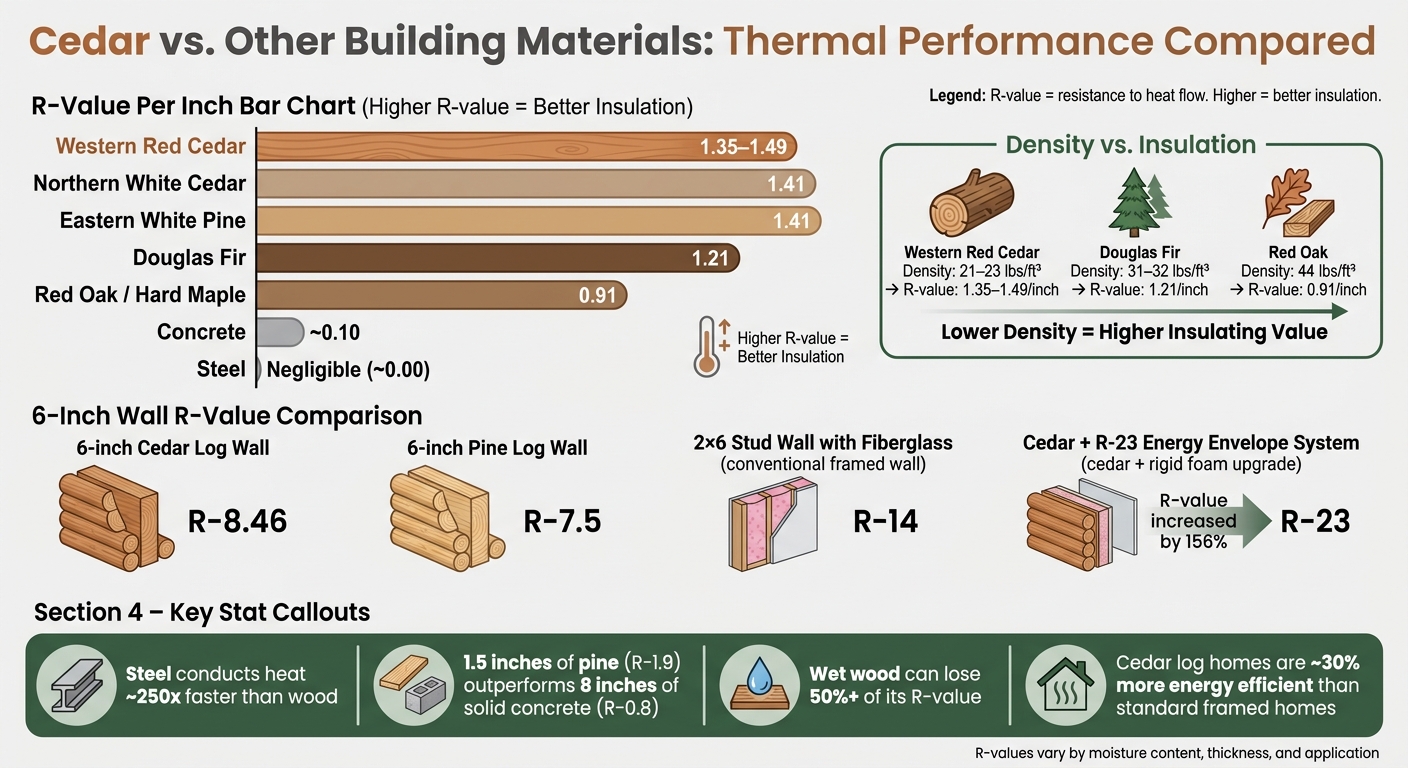
Cedar vs. Other Building Materials: R-Value & Thermal Performance Compared
Understanding R-Value and Heat Transfer
R-value measures how well a material resists heat flow – higher values mean better insulation. When it comes to wood, density plays a key role. Lower-density woods, like cedar, have more air-filled spaces, which naturally boost their insulating ability.
"Woods with low density have the highest thermal insulating value because such woods contain a high proportion of cell cavities. In dry wood, these cavities are filled with air which is one of the best known thermal insulators." – Real Cedar [1]
Wood’s anisotropic nature means heat moves 2 to 3 times faster along the grain than across it [6]. This explains why thicker cedar logs or siding offer better thermal resistance compared to thinner applications where the grain is exposed. With this in mind, cedar’s performance can be directly compared to other building materials.
Cedar’s Thermal Conductivity Compared to Other Building Materials
Western red cedar stands out for its thermal efficiency. With a k-value of 0.74 BTU inch/ft²·h·°F at 12% moisture, it delivers an R-value of 1.35–1.49 per inch. This performance surpasses denser woods and other common structural materials like concrete and steel [1][6].
| Material / Species | Density (lbs/ft³) | R-Value per Inch |
|---|---|---|
| Western Red Cedar | 21–23 | 1.35–1.49 |
| Northern White Cedar | 21 | 1.41 |
| Eastern White Pine | 25 | 1.41 |
| Douglas Fir | 31–32 | 1.21 |
| Red Oak / Hard Maple | 44 | 0.91 |
| Concrete | – | ~0.10 |
| Steel | 480+ | Negligible |
The differences are striking. Steel conducts heat at approximately 50 W/m·K, while wood typically falls between 0.10 and 0.20 W/m·K [6]. This means wood is hundreds of times better at insulating than steel. For example, a 1.5-inch piece of pine (R-1.9) outperforms 8 inches of solid concrete (R-0.8) [6]. Cedar, being less dense than pine, performs even better on a per-inch basis. A 6-inch cedar log wall, for instance, achieves an R-value of around 8.46, compared to 7.5 for a similar pine wall [2]. These characteristics highlight cedar’s potential to improve energy efficiency in modern home designs.
Why Cedar Works as an Insulator
How Cedar’s Cellular Structure Traps Heat
Cedar owes its insulating abilities to its unique cellular structure. Its long, thin cells create countless tiny air pockets, which act as natural heat traps. These air pockets, combined with cedar’s low density, significantly reduce heat transfer, keeping the wood both dry and thermally efficient [1]. Since moisture conducts heat, cedar’s naturally low moisture content plays a big role in maintaining its insulation properties – less water means better resistance to heat loss.
Cedar also provides thermal mass, which adds another layer of insulation. The U.S. Department of Energy likens logs to "thermal batteries" because they absorb heat during the day and release it slowly at night [5]. For instance, Northern White Cedar has a Thermal Mass Factor of 3.78, outperforming pine’s 2.76 in cedar vs pine log home comparisons [3]. This makes cedar walls particularly effective at regulating indoor temperatures, keeping spaces comfortable throughout the day and night.
Cedar’s insulating qualities are not just about its structure – they’re also tied to its impressive durability, which ensures consistent thermal performance over time.
Durability and Long-Term Thermal Stability
Insulation is only as good as the material’s ability to hold up over time, and cedar excels in this regard. Its cellular structure is more stable than other softwoods like pine or spruce, meaning it resists shrinking, swelling, and warping. This stability helps maintain the integrity of walls and prevents issues like drafts that could undermine insulation.
Cedar also contains thujaplicin, a natural oil in its heartwood that acts as both a fungicide and an insect repellent. This natural protection allows cedar to maintain its structural integrity for 50–60 years [7][3], making it a reliable choice for long-term use.
Builders often recommend seasoning cedar logs for at least six months before construction to stabilize any residual moisture. This step minimizes potential shrinkage and ensures a snug fit during assembly. When paired with techniques like tongue-and-groove joinery, foam gaskets, and precise caulking, cedar structures achieve a weather-tight seal. These methods help preserve cedar’s insulating performance for decades [8].
How Cedar Is Used in Home Construction
Cedar in Log Walls and Siding
Cedar plays a significant role in improving thermal efficiency in log wall construction. For instance, a 6-inch Northern White Cedar log wall has an average R-value of 8.46, which surpasses the performance of standard fiberglass insulation. Fiberglass insulation, in real-world conditions, can lose up to 28% of its R-value [10].
One of the standout features of cedar log walls is their ability to eliminate thermal bridging. In conventional 2×6 stud-frame construction, heat escapes through the wood studs, which have a lower R-value than the insulation placed between them. Cedar log walls, being solid and continuous, act as an uninterrupted thermal barrier, ensuring that heated or cooled air stays inside [10].
As noted by Big Twig Homes:
"Our northern white cedar protects your log home’s interior against heat and cold better than any other type of commonly used wood." [11]
Cedar siding also contributes to energy efficiency by providing natural insulation and shielding the wall assembly from moisture. Its natural resistance to moisture further enhances its performance [3].
Modern construction techniques take these benefits even further by integrating cedar with advanced energy-efficient systems.
Pairing Cedar with Energy-Efficient Building Systems
Combining traditional cedar construction with modern insulation systems can significantly improve energy efficiency. One effective method is the R-23 Energy Envelope system. This includes 1.5 inches of foil-faced rigid insulation and a 3/4-inch sealed air space installed against the interior of the cedar log wall. The system is then finished with cedar tongue-and-groove paneling, increasing the wall’s R-value by 156% compared to standard cedar log walls [10][12]. The 3/4-inch air space also simplifies wiring installation, eliminating the need to drill through logs.
Big Twig Homes supports this hybrid approach by offering solid cedar log home packages alongside Structural Insulated Panel (SIP) options from EPS Building Systems. SIP panels, which feature either EPS or GPS foam cores sandwiched between structural panels, create a highly airtight and well-insulated building envelope. When cedar’s natural thermal mass and moisture stability are paired with the consistent insulation performance of SIP panels, the resulting home can easily surpass standard energy code requirements. Properly constructed log homes are already about 30% more energy efficient than standard framed homes [4][9], and integrating these systems can enhance efficiency even further.
Limitations of Cedar as an Insulation Material
Cedar has its perks, but when it comes to thermal performance, it falls short of what’s needed for energy-efficient construction. This is why builders often pair cedar with additional insulation to meet modern standards.
Cedar’s R-Value vs. Specialized Insulation Materials
Cedar does provide better insulation than most other woods, but it can’t compete with materials designed specifically for insulation. Cedar’s R-value – the measure of thermal resistance – ranges from 1.41 to 1.49 per inch, depending on the species. While this is the best among woods commonly used in log homes, it’s still much lower than options like fiberglass batts, which offer around 3.14 per inch [6].
To put this into perspective, a 6-inch cedar log wall has an R-value of about 8.5 to 9. Compare that to a 2×6 stud wall with 3.5 inches of fiberglass insulation, which reaches an R-value of roughly 14. The U.S. Department of Energy highlights this gap:
"Compared to a conventional wood stud wall… the log wall is apparently a far inferior insulation system. Based only on this, log walls do not satisfy most building code energy standards." [5]
This is why cedar log walls are rarely used without supplemental insulation. For example, adding just 1 inch of rigid foam to a cedar log wall can nearly double its R-value, increasing it by 97% [2]. This upgrade helps meet today’s stricter energy codes.
How Moisture Content Affects Cedar’s Thermal Performance
Cedar’s hygroscopic nature – its ability to absorb and release moisture – adds another layer of complexity. Air-dried cedar logs typically arrive at a construction site with a moisture content of 15% to 20% [5]. As these logs dry out over time, they shrink, which can lead to gaps forming between them. These gaps allow conditioned air to escape and outdoor air to seep in, reducing the structure’s energy efficiency. As the U.S. Department of Energy explains:
"As the logs dry over the next few years, the logs shrink. The contraction and expansion of the logs open gaps between the logs, creating air leaks, which cause drafts and increase high heating and cooling requirements." [5]
Fortunately, these issues can be mitigated with thoughtful design. Steps like using kiln-dried logs (ideally with a moisture content of around 12%), sealing gaps with caulking or foam backer rods, and installing proper roof overhangs and gutter systems can help keep the logs dry and maintain their thermal performance. Incorporating these moisture control measures is essential to ensuring cedar remains effective as part of a well-designed building system.
Key Takeaways on Cedar’s Thermal Performance
Cedar stands out as a building material when its natural strengths are paired with thoughtful design. Thanks to its air-filled cellular structure, cedar boasts the highest R-value among commonly used woods in home construction. This means it offers excellent insulation. Additionally, its thermal mass allows it to store and release heat throughout the day, helping regulate indoor temperatures effectively.
However, cedar by itself may not satisfy modern energy codes in many U.S. regions. To meet these standards, it’s often necessary to combine cedar with materials like SIP panels or rigid foam for enhanced insulation.
Moisture is another crucial factor to consider. Wet wood can lose more than 50% of its R-value, as water conducts heat about 25 times faster than dry wood [6]. To maintain cedar’s thermal efficiency, it’s essential to season or kiln-dry the wood properly, seal gaps, and ensure effective drainage systems.
One of cedar’s standout qualities is its durability. Northern White Cedar, for example, contains thujaplicins, natural compounds that resist rot and insects. This resistance helps maintain its thermal properties over decades with minimal upkeep [4]. This long-lasting stability makes cedar a reliable choice for log home construction.
At Big Twig Homes, these qualities are carefully considered in their cedar log home packages. Whether you’re interested in cedar sourced through Moosehead Cedar Log Homes or high-performance SIP packages from EPS Building Systems, Big Twig Homes combines cedar’s natural benefits with modern building techniques to deliver homes that excel in energy efficiency, durability, and long-term performance.
FAQs
Will a cedar log wall meet my local energy code by itself?
When it comes to cedar log walls and energy codes, it all boils down to where you live. Cedar naturally offers some insulation and thermal mass, but in many regions, standard log walls might not meet local energy efficiency requirements. To be sure, it’s best to consult your local building code officials or state energy office.
If additional insulation is required, Big Twig Homes has you covered with specialized insulation packages designed to improve thermal performance and help meet those energy standards.
How can I improve the R-value of a cedar wall without losing the cedar look?
To improve the R-value of a cedar wall without compromising its natural look, you can install interior insulation paired with a tongue-and-groove cedar finish. Start by adding a layer of rigid insulation, like foil-faced foam or polystyrene board, to the interior side of the wall. Next, attach furring strips over the insulation to create an air gap for wiring. Finally, secure tongue-and-groove cedar boards on top, creating an effective thermal barrier while maintaining aesthetic appeal.
What moisture-control steps prevent cedar logs from shrinking and leaking air?
Big Twig Homes takes steps to address common issues like shrinkage and air leaks in cedar log homes. By using logs with naturally low moisture content, they ensure greater stability and reduce the chances of settling over time. On top of that, their precisely engineered joinery systems help each log fit snugly, creating a tight, airtight seal. These techniques result in a sturdy and moisture-resistant structure.