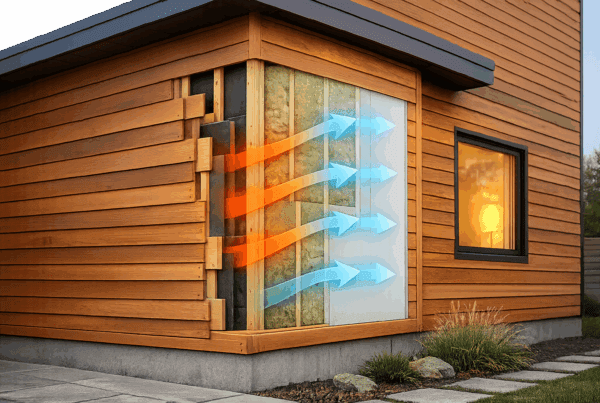


Structural Insulated Panels (SIPs) are a durable building material designed to withstand extreme weather conditions such as high winds, heavy snow, and extreme temperatures. These panels combine a rigid foam insulation core with oriented strand board (OSB) facings, creating a strong, airtight, and thermally efficient structure.
Key Takeaways:
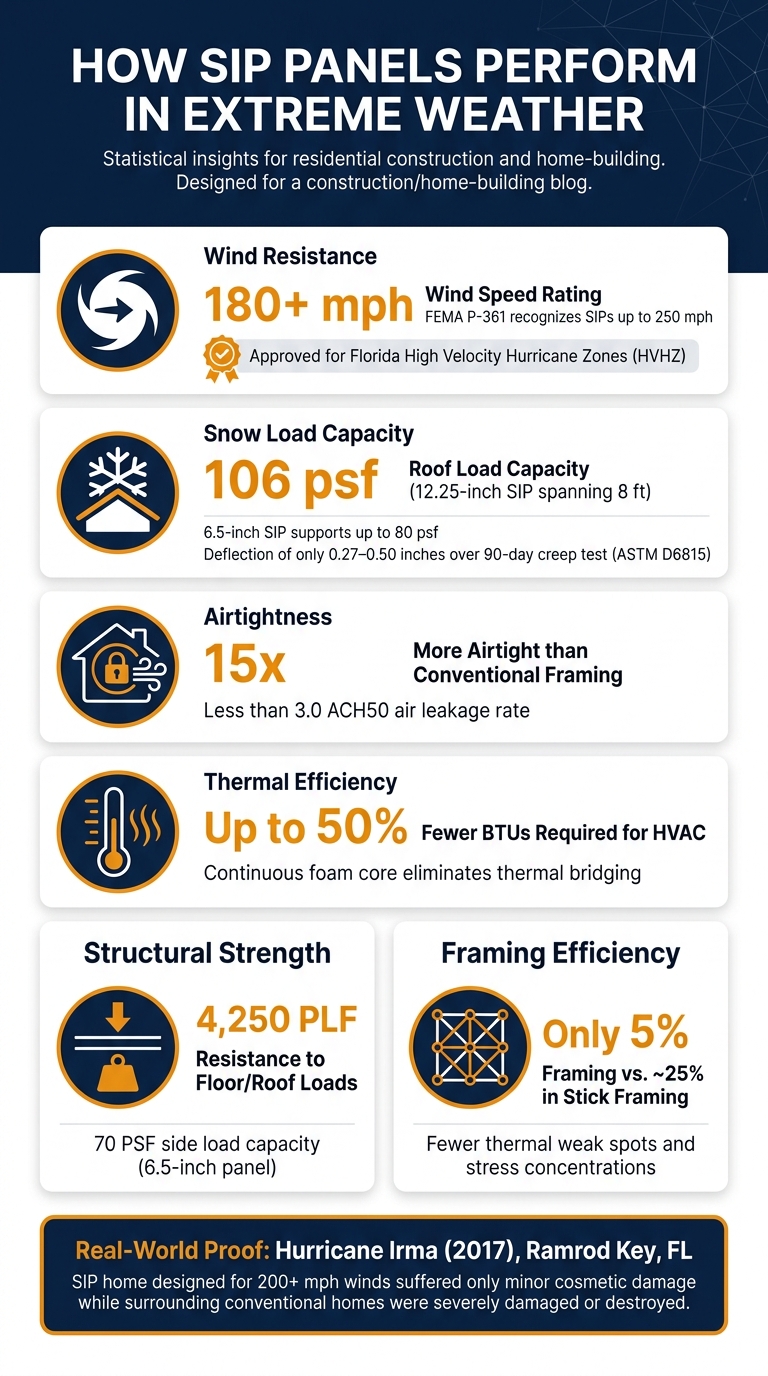
- Wind Resistance: SIPs can endure wind speeds over 180 mph and meet standards for hurricane-prone areas.
- Snow Loads: SIP roofs distribute weight evenly, supporting up to 106 psf in heavy snow regions.
- Thermal Efficiency: Continuous insulation minimizes heat transfer, reducing energy costs by up to 50%.
- Airtight Design: Homes built with SIPs experience 15 times less air leakage than conventional framing, improving temperature control and reducing moisture risks.
Proper SIP panel home construction, including airtight sealing and moisture management, is critical to ensuring SIPs perform well in extreme weather. Their strength, energy efficiency, and ability to resist environmental stresses make them a reliable choice for homes in challenging climates.
SIP Panels vs. Conventional Framing: Extreme Weather Performance Stats
Are SIP Panel Homes Hurricane Proof? | Eco-Panels of Tennessee
sbb-itb-1086e16
How SIP Panels Are Built to Handle Extreme Weather
The construction of SIP panels is the key to their resilience in extreme weather. Each panel is a solid, bonded unit with no hollow spaces or gaps between the insulation and framing. This seamless design is what sets SIPs apart when conditions get tough.
Airtightness and Continuous Insulation
In traditional stick-frame construction, insulation is placed between studs that are spaced 16–24 inches apart. These studs act as thermal bridges, allowing heat to escape in winter and seep in during summer. SIPs completely sidestep this issue. Their foam core runs continuously across the panel, eliminating breaks in thermal insulation.
This feature is especially critical during extreme weather. Whether it’s a hurricane that knocks out power for days or a winter storm that plunges temperatures below freezing, a SIP home retains its interior temperature far better than a conventional structure.
SIP buildings often achieve air leakage rates of less than 3.0 air changes per hour at 50 Pascals (3.0 ACH50) [1]. This level of airtightness also prevents moisture-laden air from entering wall assemblies, reducing the long-term risk of mold and rot. These issues are common in structures exposed to prolonged wet or humid conditions, but SIPs’ design helps mitigate them.
In addition to their thermal advantages, the monolithic design of SIPs ensures exceptional structural strength.
Structural Strength and Load Transfer
SIPs are engineered as a unified system that efficiently distributes loads. This continuous construction not only maintains thermal performance but also enhances their ability to handle structural stresses during extreme weather. As FischerSIPS explains:
"SIPs act as a unified diaphragm that distributes loads across the entire panel surface." [6]
Instead of relying on individual studs to channel loads, SIPs spread forces like wind pressure, snow weight, and lateral stresses across the entire panel. This creates continuous shear walls with fewer joints and fasteners compared to stick-frame designs. Fewer joints mean fewer weak points that could fail under storm conditions.
For example, a 6.5-inch SIP panel can withstand a side load of up to 70 pounds per square foot (PSF) [9]. Additionally, SIP panels have been shown to resist 4,250 pounds per lineal foot (PLF) from floor or roof loads [9]. This impressive strength comes from the panel’s bonded, monolithic structure, where all components work together seamlessly rather than independently.
Wind Resistance: How SIP Panels Perform in High Winds
SIP panels are built to handle intense wind loads. Their design combines OSB facers, which act as flanges, with a rigid foam core serving as the web. This creates a structure with a high strength-to-weight ratio, allowing SIPs to resist both racking and bending under sustained wind pressure. The way SIPs distribute loads continuously across their surface makes them especially effective at withstanding wind forces. These panels are rated to endure wind speeds exceeding 180 mph [1][5]. FEMA‘s P-361 guidance even recognizes SIP systems as capable of withstanding winds up to 250 mph and debris impacts at speeds of 100 mph [6]. For added confidence, they’re approved for use in Florida’s High Velocity Hurricane Zones (HVHZ) [1].
Panel-to-Panel Connections
When SIP panels are properly connected, they function as a unified structure rather than separate components. Splines – whether surface splines, insulated splines, or structural lumber – bridge the gaps between panels, ensuring structural continuity across walls or roofs. This creates a continuous shear wall, which spreads wind loads evenly across the entire panel surface rather than concentrating stress on specific studs or fasteners.
"SIP wall panels create continuous shear walls that are inherently more resistant to lateral wind loads compared to stick-frame assemblies, which have more joints, fasteners, and pathways for failure." – FischerSIPS [6]
Using larger panels also reduces the number of seams, which minimizes potential weak points. A compelling example of this occurred in September 2017, when a SIP-constructed home in Ramrod Key, Florida, weathered Hurricane Irma’s Category 4 winds – designed for 200+ mph wind loads – suffering only minor cosmetic damage. In contrast, surrounding conventional homes experienced severe structural damage or complete destruction. The SIP home’s continuous envelope prevented breaches and uplift, showcasing its superior wind resistance [6].
Proper sealing is another critical factor that enhances the performance of SIPs in high-wind conditions.
Sealing and Fastening Details
Strong connections aren’t enough on their own – airtight sealing is equally important. During windstorms, pressure differences can drive air and water through even small gaps. Joseph Lstiburek of Building Science Corporation emphasizes the importance of redundancy in sealing:
"At panel joints seal the heck out of them at the interior as well as close to the interior…two locations…belt and suspenders…systems redundancy…" [3]
This means applying sealant thoroughly at both interior sides of panel joints. Materials like SIP-specific sealant, expanding foam, or self-adhesive SIP tape are commonly used to ensure airtightness. Double-sealing not only keeps air out but also prevents moisture from infiltrating the panels over time, preserving their integrity.
Key Installation Practices for Wind Resistance
Proper installation is essential to fully utilize the strength of SIP panels in high-wind areas. Here are a few key practices to follow:
- Stick to the fastening schedule. Manufacturers design these schedules to meet specific uplift and lateral load requirements. Skipping or altering fasteners can compromise performance in high-wind zones.
- Support the outer facing. The exterior face of the SIP must have continuous structural support along its bottom edge at the sill plate to avoid buckling under wind pressure [10].
- Test for air leaks. Conduct blower door testing or use smoke pencils before closing walls with drywall. This helps identify and fix any air leaks at panel seams while adjustments are still manageable [10].
For those building in hurricane-prone or high-wind areas, verifying that your SIP assembly is listed in the Florida Product Approval database – or has equivalent HVHZ certification – ensures it has been rigorously tested to meet those demands [6].
Snow Loads: How SIP Roofs Handle Weight and Moisture
How SIP Roofs Distribute Snow Loads
SIP roofs are built to handle heavy snow and moisture with impressive efficiency. They distribute snow loads much like a steel I-beam does. The outer OSB (oriented strand board) skins resist bending forces, while the rigid foam core absorbs shear forces and spreads the weight evenly across the entire roof panel.
"The structural properties of a ‘SIP sandwich’ resemble a steel I-beam. The OSB act as the flange, resisting most of the bending movement. The rigid foam core acts as the web, which effectively absorbs shear force." – Extreme Panel Technologies [9]
For example, a 6.5-inch SIP can support up to 80 psf in roof applications, which meets or exceeds most snow load requirements across the U.S. Meanwhile, a 12.25-inch SIP spanning 8 feet can carry up to 106 psf [11]. These panels are also designed to resist creep under prolonged snow loads. In a 90-day test, 6.5-inch panels showed deflections of just 0.27 to 0.50 inches, while 12.25-inch panels deflected between 0.41 and 0.66 inches – all within ASTM D6815 safety standards [4].
Roof Slope and Support Design
The strength of SIP roofs allows for wider spans between support members compared to traditional stick framing. For instance, while conventional framing might need supports every 4 feet to handle a 55 psf load, a 6.5-inch SIP can span 8 feet and carry the same load [11]. This reduces the need for beams and purlins, maintaining structural performance with fewer materials.
For particularly long spans or areas with heavy snow loads, additional structural capacity can be achieved by embedding I-joists or dimensional lumber splines directly into the panels. SIP construction uses only about 5% framing, compared to nearly 25% in stick framing [11]. This design minimizes thermal weak spots and stress concentrations, ensuring the roof performs well under load while also addressing energy efficiency.
Moisture Control Strategies
Handling snow loads is only part of the challenge – managing moisture is just as important in snowy climates. Melting snow can refreeze at the eaves, creating ice dams that push water under shingles. In regions where the ground snow load exceeds 50 lb/ft², a vented over-roof (or cold roof) is recommended to prevent this issue.
"A vented ‘over roof’ needs to be installed over the SIPS in locations where the ground snow load is greater than 50 lb/ft² (244 kg/m²)." – Joseph Lstiburek, Principal, Building Science Corporation [3]
The typical assembly for a vented over-roof includes a vapor-open underlayment directly on the SIP surface, vertical 2×4 furring spaced 24 inches apart, horizontal 1x4s, and a final layer of OSB or plywood sheathing. This setup creates a ventilated gap that keeps the roof deck cold, preventing ice dams and reducing the risk of telegraphing – where panel joints become visible through asphalt shingles due to temperature or moisture changes [3].
Special care should be taken at the ridge joint, which is highly prone to moisture issues like ridge rot, caused by warm interior air leaking and condensing in the cold roof assembly. To prevent this, it’s crucial to use high-quality sealants on both the interior and exterior faces of the joint [3]. Additionally, in areas with heavy snow where ridge vents may get buried, cupolas can be added along the ridge to maintain proper ventilation. These features ensure the over-roof remains connected to outside air, even under deep snowpack [3].
Heat and Cold Performance: How SIPs Manage Extreme Temperatures
Thermal Resistance and Reduced Heat Transfer
SIPs (Structural Insulated Panels) aren’t just about standing strong against wind and snow – they also shine when it comes to maintaining comfortable indoor temperatures, no matter the season. A key reason for this is their ability to minimize thermal bridging. Unlike traditional framing, which often has interruptions in the insulation layer, SIPs provide a continuous insulation barrier.
The rigid foam core – made from either EPS (Expanded Polystyrene) or GPS foam – spans the entire panel face. This design ensures a seamless layer of insulation, dramatically reducing heat transfer during both the blazing heat of summer and the freezing chill of winter.
"The rigid foam core… provides continuous insulation that prevents heat from penetrating the building. Unlike traditional framing… SIPs create a seamless, airtight barrier that significantly reduces heat gain." – Capital Forest Products [12]
Thanks to this efficient insulation, homes built with SIPs can use HVAC systems that require up to 50% fewer BTUs, cutting both equipment costs and energy consumption [11]. However, the effectiveness of this insulation heavily depends on properly sealed joints, as gaps can compromise its thermal benefits.
Sealing to Control Heat Loss and Gain
SIPs’ nearly airtight construction takes their thermal performance to the next level. This tight seal helps keep hot air out during summer and traps conditioned air inside during winter, ensuring year-round comfort.
"Their airtight construction ensures indoor comfort during temperature extremes, even during power outages." – Extreme Panel Technologies [5]
However, this airtightness comes with a catch: proper mechanical ventilation is a must. Without it, indoor humidity levels can rise, potentially leading to mold and damp conditions. As Jack Armstrong, Executive Director/COO of the Structural Insulated Panel Association (SIPA), points out:
"The nearly airtight nature of the SIP structures, while beneficial for long-term durability and fire resilience, necessitates mechanical make-up air to prevent mold and dampness, which can compromise structural integrity if left unaddressed." [11]
To fully capitalize on SIPs’ energy efficiency, HVAC systems should be carefully sized using ASHRAE Manual J guidelines. Oversized systems in a SIP home can lead to short cycling – turning off too quickly before properly dehumidifying the air – potentially causing discomfort and moisture issues over time [11]. Properly sized systems ensure a balance of energy savings and indoor comfort. To ensure your home is optimized for these efficiencies, you can book a free SIP home consultation with our experts.
Installation Details That Affect Weather Durability
Even the toughest SIP panels can fall short if they’re not installed correctly. Proper sealing, moisture control, and secure connections are key to ensuring long-lasting performance.
Air Sealing and Joint Treatment
The joints between panels are the weakest spots in any SIP assembly. Even small gaps can let air and moisture seep through over time, causing energy loss, water damage, and, in severe cases, structural problems – especially in critical areas like the roof ridge.
Building scientist Joseph Lstiburek from Building Science Corporation emphasizes the importance of sealing joints thoroughly. His advice? Use redundant sealing methods. Start by applying continuous beads of manufacturer-approved caulk along all seams before assembly. Then, reinforce these seams with peel-and-stick tape applied to the interior joints. To give you an idea of the scale, sealing a 1,200-square-foot home might require over 5,000 linear feet of caulk to create an airtight envelope [10]. The roof ridge needs extra care, with multiple beads of caulk and a specialized ridge cap to prevent issues like "ridge rot", which occurs when warm air escapes and condenses [3][10].
When it comes to splines, insulated or surface splines are the go-to choice for most joints because they maintain thermal continuity. Structural splines made from solid 2x lumber should only be used when specific load-bearing requirements demand them, as they can create thermal bridges at the joint [10].
Sealed joints ensure airtightness, but flashing and moisture barriers are equally critical to protect the panels from exterior elements.
Flashing and Moisture Barriers
Sealing alone isn’t enough – managing moisture from the outside is just as important. Lstiburek highlights the main risk with SIP construction:
"The single greatest concern with SIPS is their ability to control rain water entry. In this regard, SIPS should be treated similarly to wood frame construction where OSB or plywood is used as an exterior sheathing." – Joseph Lstiburek, Building Science Specialist [3]
This means wrapping the exterior with one or two layers of high-permeability house wrap to create a drainage plane behind the cladding. For windows and doors, proper flashing and integrated sill pans are essential to channel water away from the panels, much like in conventional framing [10]. On roofs, a vapor-open underlayment installed directly over the SIPs allows trapped moisture to escape while keeping water out [3].
In areas with heavy snow loads – above 50 lb/ft² – a vented "over-roof" system is strongly recommended. This system includes a vapor-open underlayment, vertical 2×4 furring strips spaced 24 inches apart, horizontal 1x4s, and an additional layer of sheathing. Together, these layers create an air gap above the SIPs, helping to prevent ice dams and reducing the risk of panel joints becoming visible under asphalt shingles over time [3].
Connecting SIPs to Foundation and Roof Systems
Proper connections to the foundation and roof are just as important as sealing and flashing. SIPs require a plumb, level, and square foundation, as they are less forgiving of uneven surfaces than traditional stick framing [10].
To prevent moisture migration, install a capillary break using aluminum flashing and a termite shield between the sill plate and the foundation [10]. The SIP’s exterior face must rest on continuous structural support along its entire bottom edge, sitting securely on the top plate rather than hanging over the edge [10].
Once the SIP shell is in place, perform a blower door test before adding drywall. This test, combined with a smoke pencil inspection, helps identify air leaks, including those around electrical boxes and wire chases. Any leaks can be sealed with low-expanding foam before finishing the interior surfaces [10].
Choosing the Right SIP Materials for Extreme Weather
Panel Skins and Foam Core Options
Selecting the right SIP materials for efficient home construction is a key step toward ensuring your structure can handle extreme weather conditions. Most SIPs are built using oriented strand board (OSB) as the structural facing on both sides. The combination of OSB skins and a rigid foam core works together to evenly distribute loads and maintain thermal efficiency. For areas where termites are a concern, using borate-treated OSB and foam cores can provide added protection.
The foam core is a critical component for thermal performance, and you have two primary options: Expanded Polystyrene (EPS) and Graphite Polystyrene (GPS). EPS is widely used because it’s dependable, affordable, and works well in most climates [7]. GPS, often referred to as Neopor, is a graphite-infused version of EPS that offers higher R-values for the same panel thickness. This makes GPS an excellent choice for homes in regions with extreme heat or cold [7]. In areas with significant temperature swings, GPS cores can achieve superior insulation without requiring thicker walls.
For High-Velocity Hurricane Zones (HVHZ), 6.5-inch EPS-core SIPs meet stringent requirements and have passed missile-impact tests [6]. In snowy regions, thicker panels – up to 12.25 inches – are designed to withstand the long-term "creep" loads caused by heavy snowpack on roofs [4]. These material choices directly affect how well SIPs perform under extreme weather conditions, bridging the gap between design and durability.
Working with Reliable SIP Suppliers
The quality of SIP materials is only as good as the manufacturing process behind them. To ensure your SIPs deliver consistent, weather-resistant performance, source them from suppliers with an ICC-ESR report (e.g., ICC-ESR 4689 or ICC-ESR 4524). These reports verify that the panels meet building code requirements [4][2].
Big Twig Homes partners with reputable SIP manufacturers like EPS Building Systems to offer panel packages designed for real-world challenges. Their SIP packages include technical support and installation guidance – essential for regions where weather conditions demand more from your materials. Working with experienced suppliers also gives you access to important resources such as load-design charts, fire-performance data, and advice on selecting panels that meet your local building codes and climate requirements [7][8].
To maximize performance, request your supplier’s technical documentation. This should include details on long-term load capabilities and results from one-hour fire-resistance tests conducted under ASTM E119 standards. These documents will help ensure compliance with local codes and confirm the materials’ ability to withstand extreme weather [1][5].
Conclusion: Building Weather-Resistant Homes with SIP Panels
SIP panels stand out in extreme weather conditions thanks to their solid construction, continuous insulation, and airtight design. In fact, homes built with SIPs are 15 times more airtight than those with traditional framing[5]. This level of airtightness helps retain heat during winter, keeps interiors cool in summer, and maintains stable indoor temperatures during power outages.
Real-world examples highlight these advantages. Data shows that SIP homes endure extreme wind loads with minimal damage compared to conventional structures[6]. This resilience comes from the way SIPs are engineered to function as a single, unified structure, combined with careful sealing, fastening, and moisture management during installation.
"Structural Insulated Panels are not just an alternative to stick framing – they’re an upgrade. From hurricane winds in Florida to wildfires and earthquakes in California, SIPs provide superior resilience, energy performance, and occupant safety." – FischerSIPS[6]
The key to maximizing the benefits of SIPs lies in material quality and precise installation. Factors like choosing between EPS or GPS foam cores, selecting the right panel thickness for your region’s snow or wind conditions, and ensuring panels have verified ICC-ESR documentation all contribute to long-lasting performance.
Big Twig Homes partners with leading manufacturers, such as EPS Building Systems, to provide SIP packages supported by expert guidance. When installed correctly, SIP panels equip your home to withstand hurricane-force winds, heavy snow loads, and extreme temperatures. They offer dependable wind, snow, and thermal protection, making them a smart choice for building durable, weather-resistant homes.
FAQs
Do SIP homes need special HVAC sizing or ventilation?
SIP homes are known for their airtight construction, which makes proper HVAC sizing and ventilation absolutely essential. Standard HVAC systems are often too large for the energy efficiency these homes provide. To get it right, a qualified professional should carry out a detailed load calculation to ensure your HVAC system is sized appropriately.
Beyond that, mechanical ventilation is a must. It helps maintain good indoor air quality, manages moisture levels, and ensures your home remains a healthy and comfortable place to live.
When is a vented over-roof required on a SIP roof?
When the ground snow load exceeds 50 lb/ft² or annual rainfall goes over 20 inches, a vented over-roof becomes essential. This design helps water and vapor to dry effectively, reducing potential moisture issues. Some experts even suggest venting all SIP roofs as a precaution against problems like ice dams and ridge rot.
To ensure proper airflow in a vented roof, make sure to include an air inlet at the fascia. Adding ridge ventilation can further improve the system’s efficiency.
What SIP thickness should I use for my local wind and snow loads?
The thickness of Structural Insulated Panels (SIPs) should match your specific structural requirements, such as wind resistance and snow load capacity. SIPs are available in thicknesses ranging from 4-1/2 inches to 15 inches. For most residential applications, 6-1/2-inch panels are a solid choice. They can handle roof loads up to 80 pounds per square foot (psf), which is sufficient for typical snow loads in the U.S. However, if your project involves more extreme conditions, 12-1/4-inch panels or thicker may be necessary for added strength. Always check with a structural engineer and follow local building codes to ensure safety and compliance.