
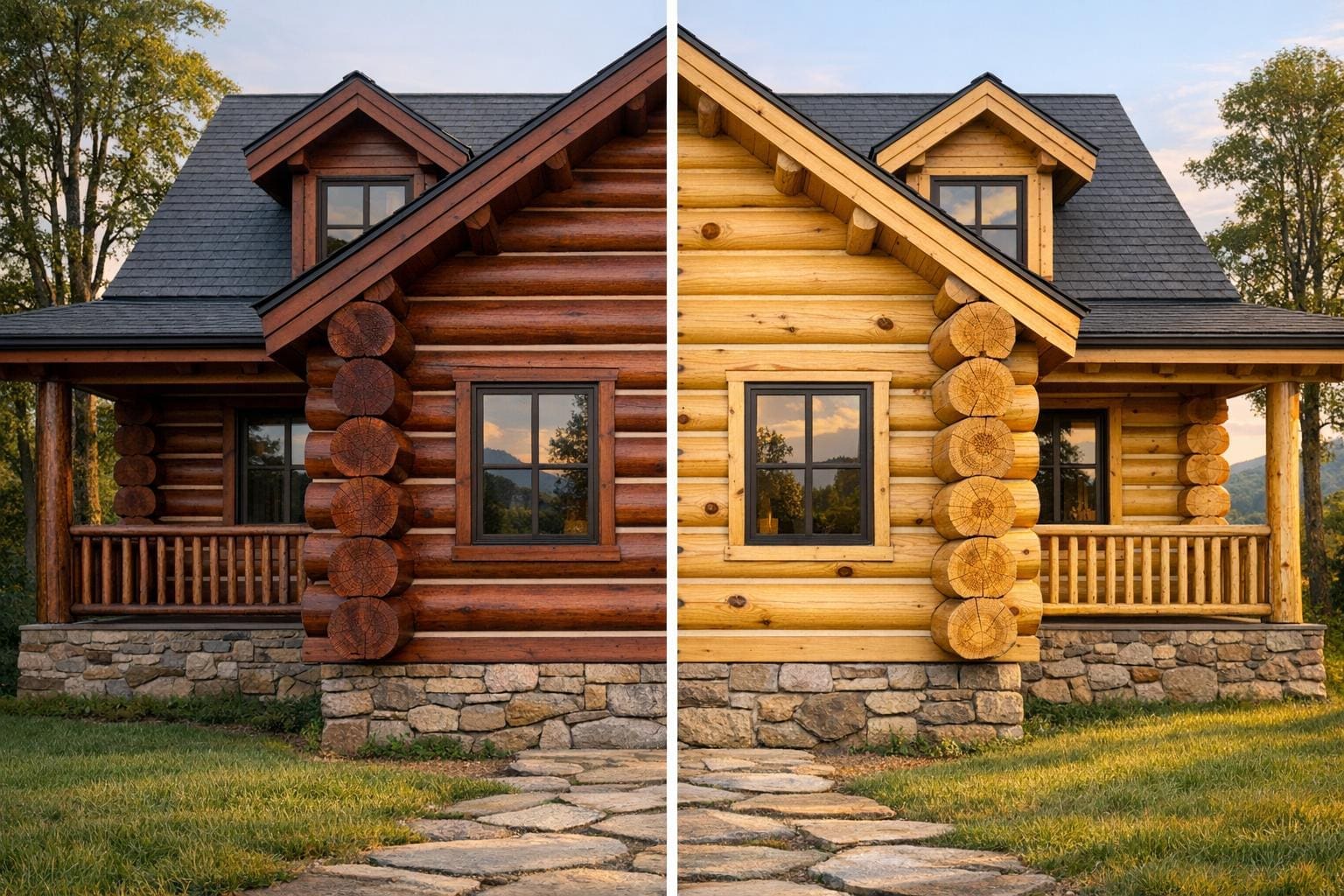
Building a log home in the Appalachian region means choosing a wood that can handle hot summers, heavy rainfall, and cold winters. Two popular options are cedar and pine, each with distinct strengths and weaknesses. Here’s what you need to know:
- Cedar: Offers natural resistance to rot, pests, and moisture. It requires less maintenance, has better insulation (R-value of 1.41 per inch), and is more stable with minimal shrinkage. However, it costs more upfront.
- Pine: More affordable and widely available. It’s strong and versatile but lacks natural defenses, requiring frequent treatments and maintenance. Pine is prone to cracking, settling, and sap leakage over time.
Quick Overview:
| Feature | Cedar | Pine |
|---|---|---|
| Rot/Insect Resistance | High (natural oils) | Low (needs treatment) |
| Shrinkage/Settling | Minimal | Up to 2–3 inches |
| R-Value (Insulation) | 1.41 per inch | 1.12–1.25 per inch |
| Maintenance | Low | High |
| Cost | Higher upfront | Lower upfront |
Cedar is better for long-term durability and low maintenance, while pine is ideal for tighter budgets but requires ongoing upkeep. Your choice depends on priorities like cost, maintenance, and climate resilience, which you can discuss during a free consultation.
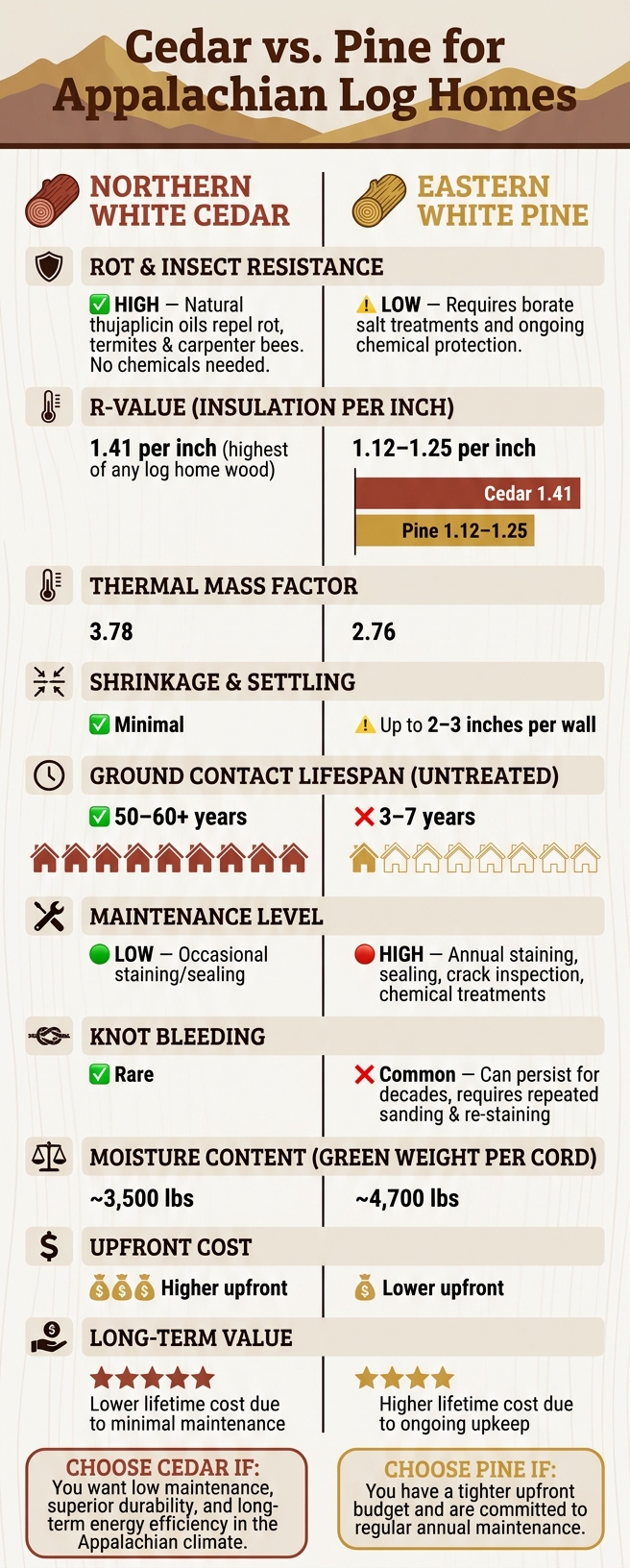
Cedar vs. Pine for Log Homes: Side-by-Side Comparison
What Log Fiber is Best to Build a Log Home?
sbb-itb-1086e16
Cedar and Pine: Key Characteristics
Let’s dive into the distinct features of cedar and pine, two softwoods that have long been staples in American log home construction. While both are popular choices, their natural properties vary significantly – differences that are especially relevant for homes built in the challenging Appalachian environment.
Cedar: Durability and Stability Built In
Northern White Cedar stands out for its natural defenses. It produces thujaplicins, compounds that act as preservatives, giving it strong resistance to decay, rot, moisture damage, and pests like termites and carpenter bees[2][7]. Once installed, cedar is remarkably stable. Its lower green moisture content – around 3,500 lbs per cord compared to pine’s 4,700 lbs – means it dries faster and more uniformly[2]. While cedar does experience some checking (surface cracking), these cracks are typically shallow and don’t compromise the wood’s core, allowing protective finishes to remain effective. Even untreated cedar posts can last an impressive 50–60 years in ground-contact conditions[10].
Pine: Strength and Accessibility
Pine is favored for its strength, availability, and cost-effectiveness. Eastern White Pine, in particular, is a go-to choice in the Southeast, thanks to its local abundance[6]. However, pine falls short in natural resistance to rot and pests. With a higher initial moisture content, it’s more prone to deeper checking, shrinkage, and settling – sometimes up to 2–3 inches per wall[6][5]. Another challenge with pine is "knot bleeding", where resin and sap seep from knots, often requiring repeated sanding and re-staining for years[9].
"Pine is the most common log home wood in the United States… However, Pine is a ‘softwood’ with low natural resistance to rot." – Jim McCain, Weatherall[6]
These differences become even more pronounced under Appalachian conditions, where the climate puts both woods to the test.
The Appalachian Climate’s Impact on Cedar and Pine
The Appalachian region’s damp and variable climate can significantly affect log home materials. For pine, high moisture absorption speeds up checking and creates opportunities for insects and fungi to invade. Without immediate treatment – such as applying borate salts – pine logs can deteriorate quickly[6]. Cedar, on the other hand, fares better. Its lower moisture content and natural decay resistance mean it requires less frequent maintenance, even in the wet conditions typical of states like Tennessee and North Carolina. As Appalachian Log & Timber Homes, a company with nearly five decades of experience, points out, understanding these wood-specific traits is crucial for building long-lasting homes in the region.
| Feature | Northern White Cedar | Eastern White Pine |
|---|---|---|
| Natural Rot Resistance | High (contains thujaplicins)[7] | Low (requires treatment)[6] |
| Insect Resistance | High (naturally repels termites/bees)[6] | Minimal without treatment[6] |
| Green Weight (per cord) | ~3,500 lbs[2] | ~4,700 lbs[2] |
| Dimensional Stability | High (minimal shrinking/warping)[2] | Low (prone to checking/settling)[6] |
| R-Value per Inch | 1.41[2] | 1.12–1.25[7] |
| Knot Bleeding | Rare[9] | Common (can persist for decades)[9] |
This side-by-side comparison highlights how each wood’s natural properties influence performance, especially in the Appalachian region’s demanding climate.
Cedar for Appalachian Log Homes
Cedar is a natural fit for Appalachian log homes, thanks to its ability to handle the region’s humidity, temperature fluctuations, and pests.
Durability and Maintenance
One of cedar’s standout features is its natural resistance to rot, insects, and moisture, which translates to less upkeep compared to other log home materials. Its thujaplicin oils act as a built-in defense against decay and wood-boring insects, which means it doesn’t require the chemical treatments that pine often needs. This not only reduces the frequency of maintenance but also cuts down on treatment expenses. Even when left untreated, cedar posts can last for decades. Beyond its durability, cedar also contributes to a more comfortable indoor environment.
"Cedar is a standout for its longevity and natural resistance to the elements. It doesn’t need as much chemical treatment as pine and can often go longer without staining or sealing." – ETBS Staff, East Tennessee Building Supply [3]
Energy Efficiency and Comfort
Cedar logs provide excellent insulating properties for a solid wood material. For example, Northern White Cedar boasts an R-value of 1.41 per inch, the highest among woods commonly used in log home construction, paired with a Thermal Mass Factor of 3.78 (compared to 2.76 for pine) [2]. Cedar’s ability to absorb heat and release it slowly helps regulate indoor temperatures, keeping homes cooler during the day and warmer at night. Additionally, its low moisture content – typically around 12–16% when air-dried – ensures dimensional stability. This stability minimizes cracking and air leaks, which can otherwise lead to higher energy bills [4][11].
"Cedar’s low moisture content and superior stability avoid all these problems [cracking, shrinkage, air seepage] and allow for added insulation." – Big Twig Homes [5]
Aesthetic Appeal
Cedar brings a natural warmth and character that fits seamlessly into Appalachian landscapes. Its reddish-brown tones and aromatic woodgrain complement the stonework, dark trims, and natural surroundings often seen in mountain homes. Over time, untreated cedar develops a silvery-grey patina, which many homeowners find equally appealing. Unlike pine, cedar experiences minimal checking and rarely leaks sap, allowing the logs to maintain their appearance over the years without the surface imperfections commonly associated with pine [2][12].
"Cedar log homes provide a rich, warm appearance that complements detailed timber framing and elevated interior finishes." – Aaron Dunn, Big Twig Homes [1]
Cost Considerations
While cedar typically comes with a higher upfront cost compared to pine, this is largely due to factors like harvesting locations and transportation. However, cedar’s reduced maintenance needs and energy efficiency can help balance out these initial expenses over time. Some manufacturers, particularly those near sustainable cedar forests or using zero-waste processing, may offer cedar packages at prices that compete with pine [2][4]. Ultimately, factors like shipping distance, home design complexity, and site conditions will affect the final cost, so getting a detailed quote tailored to your project is essential.
Pine for Appalachian Log Homes
Pine is a popular choice for log homes in the Appalachian region, thanks to its availability, affordability, and the classic rustic charm it brings. However, using pine comes with its own set of challenges, especially in this region’s climate.
Durability and Maintenance
Pine, unlike cedar, lacks natural resistance to rot, decay, and wood-boring insects [3][6]. This is particularly concerning in the Appalachians, where the humid climate exacerbates these vulnerabilities. Pine logs contain significantly more moisture than cedar – about 2.5 times as much – which leads to noticeable shrinkage and settling over time, sometimes up to 2–3 inches per wall as the wood dries out [6].
This high moisture content also makes pine susceptible to "Blue Stain" fungus if not properly treated [6]. To combat this, pine logs should be kiln-dried at approximately 170°F to eliminate insects, eggs, and larvae. After the logs are erected, immediate treatment with borate salts, such as Tim-bor, is essential [6][13]. Additionally, flexible chinking is critical to accommodate the ongoing movement of the wood [6].
"You cannot leave Pine unprotected for even a single season." – Jim McCain, Weatherall [6]
Regular maintenance is non-negotiable. Pine logs require annual staining and sealing with UV-protective products to prevent moisture damage [6]. Cracks in the logs can expose untreated wood, reducing the effectiveness of surface treatments [2]. These maintenance demands make it essential to weigh pine’s initial benefits against cedar’s durability. Pine’s susceptibility to these issues also impacts its energy performance, which we’ll explore next.
Energy Efficiency and Comfort
Pine logs provide natural thermal mass, which helps regulate indoor temperatures. During the day, pine walls absorb heat and release it slowly at night, creating a more consistent indoor climate. An 8-inch solid pine log wall can perform on par with a conventional R-19 framed wall in terms of heating and cooling efficiency [15]. Properly designed log homes can even be 15% to 20% more energy efficient than traditional stick-built homes [14].
However, achieving this efficiency with pine requires meticulous sealing. Key areas like foundations, log connections, and roof-wall transitions must be carefully sealed. Compression foam gaskets and specialized caulks that adapt to the wood’s natural movement are essential to maintain airtightness.
Aesthetic Characteristics
Pine isn’t just practical – it’s visually appealing too. Its light golden or creamy white tone creates a bright and inviting atmosphere [6][3]. The wood’s smooth and uniform surface complements both traditional and modern interior designs.
Pine’s ability to absorb stains gives homeowners plenty of design options [16][8]. Since it doesn’t have the natural oils found in cedar, pine takes stains easily, allowing for a wide range of colors. Want the warm reddish tones of cedar without the cedar price tag? A carefully chosen stain can make pine look remarkably similar.
"White Pine is very receptive to stain, making it a fantastic choice for a wide range of color possibilities. In fact, you can even enjoy a gorgeous Cedar color with Pine wood." – Gingrich Builders [8]
This versatility in design is one of the reasons pine remains the top choice for log homes in Tennessee and throughout the Appalachian region [3]. If you are planning a build, you can find cedar log homes in NC, SC, GA, and TN through local suppliers.
Cost Considerations
Pine’s lower upfront cost is one of its biggest selling points. Its abundance in the Appalachian region reduces transportation costs, making it an economical option compared to cedar, which often has to be sourced from the Pacific Northwest or Canada [3][8].
However, long-term maintenance costs can add up. Regular staining, sealing, and addressing cracks or settling are ongoing expenses. In the Appalachian climate, untreated pine in contact with the ground has a lifespan of only 3 to 7 years [2][4]. Proper foundation clearance and moisture barriers are critical to extending the life of a pine log home.
Cedar vs. Pine: A Direct Comparison
Durability and Resistance
When it comes to standing up to the Appalachian climate, cedar and pine show clear differences. Northern White Cedar naturally produces thujaplicins, which protect it from rot, decay, and pests like termites and carpenter bees – no chemical treatments needed. Pine, on the other hand, lacks these natural defenses and needs regular treatments to achieve similar protection.
Cedar’s closed-cell structure works like cork, repelling water effectively. Pine, with its open-cell structure, readily absorbs moisture, which can be a problem in the region’s humid, rainy seasons. Untreated Northern White Cedar can last 50–60+ years in direct ground contact, while untreated pine generally only lasts 3–7 years under the same conditions [10].
Another drawback of pine is its tendency for knot bleeding, where resin and sap seep out for years, necessitating repeated sanding and re-staining. Cedar, however, doesn’t have this issue.
Energy Performance
Cedar also has the edge in insulation. Northern White Cedar boasts an R-value of 1.41 per inch, which is 26%–30% higher than the R-value range of 1.12–1.25 typical for pine used in log construction [2][9]. Additionally, cedar’s superior Thermal Mass Factor (3.78) compared to pine’s (2.76) means it retains and releases heat more effectively, which is a big plus for the Appalachians’ varying seasons.
"Northern White Cedar has the highest R-value of any of the species used in log homes." – Katahdin Cedar Log Homes [2]
Pine also shrinks more – by 2–3 inches per wall – leading to gaps that can weaken energy efficiency. Cedar, with minimal shrinkage, keeps seams tight and maintains insulation over time.
Aesthetics and Design Options
The visual appeal of both woods is undeniable, but they offer different vibes. Cedar’s reddish-brown tones deepen over time, giving homes a warm, natural look. Pine’s lighter golden or creamy white color creates a brighter aesthetic and is highly receptive to stains, offering more customization for finishes.
However, pine’s flexibility with stains comes at a cost. Without the natural oils found in cedar, pine relies entirely on surface treatments for protection against moisture and UV exposure. Once cracks appear in pine logs, the exposed areas become vulnerable unless they’re carefully maintained [2].
Upfront Cost and Long-Term Value
Pine’s biggest advantage is its lower upfront cost, especially since it’s readily available in the Appalachian region. Cedar, while initially more expensive, can offer better value over time when you consider the following:
- Maintenance: Cedar needs less frequent upkeep, while pine requires regular staining and sealing.
- Treatment: Pine depends on chemical treatments for protection, which adds to ongoing costs. Cedar doesn’t need any.
- Longevity: Cedar’s durability means fewer repairs and replacements over the years.
| Factor | Northern White Cedar | Pine |
|---|---|---|
| Natural rot/insect resistance | High (no chemicals needed) | Low (requires ongoing treatment) |
| R-value per inch | 1.41 [2] | 1.12–1.25 [2][9] |
| Shrinkage/settling | Minimal | Up to 2–3 inches per wall [6] |
| Knot bleeding | None | Can persist for decades [10] |
| Ground contact lifespan (untreated) | 50–60+ years [10] | 3–7 years [10] |
| Maintenance level | Low to moderate | High |
When weighing these factors, it’s clear that your choice between cedar and pine will depend on your priorities – whether it’s upfront savings or long-term durability and reduced maintenance. If you’re ready to compare specific costs for your project, you can request a free estimate to get started.
Choosing the Right Wood for Your Appalachian Log Home
Matching Wood Species to Your Priorities
The type of wood you choose for your log home should align with your priorities. If you’re ready to build your dream log home and want to keep maintenance to a minimum, cedar is a great option. According to ETBS Staff, cedar offers excellent long-term protection, making it ideal for those seeking a low-maintenance investment.
On the other hand, if upfront costs are a bigger concern, pine can be a more affordable choice. However, it requires a commitment to regular upkeep, including annual sealing, staining, and inspections. Pine’s higher moisture content makes maintenance essential to ensure its durability.
Once you’ve chosen the wood that best fits your needs, focusing on thoughtful architectural design can further protect your log home and enhance its longevity.
Design and Site Considerations
After selecting the right wood, smart design choices can make a big difference in how well your log home holds up in the Appalachian climate. Features like wide roof overhangs help protect log walls from the region’s frequent rain. Combine that with proper drainage grading around the foundation and metal flashing above windows and doors to limit water exposure to the logs.
For log homes in particularly wet or hard-to-reach areas, cedar’s natural resistance to moisture becomes even more important. In contrast, pine in a high-humidity, remote location can lead to faster wear and tear, especially if maintenance is difficult to perform regularly.
How Big Twig Homes Can Help
With the right combination of wood selection and thoughtful design, Big Twig Homes provides customizable Northern White Cedar log home packages tailored for the Southeastern U.S. climate. Their packages are specifically designed for areas like the mountains of North Carolina, Tennessee, South Carolina, and Georgia.
Founded by Aaron and Meredith Dunn, Big Twig Homes partners with trusted suppliers such as Moosehead Cedar Log Homes to source Northern White Cedar. This allows them to offer cedar packages at competitive prices, often comparable to pine when material lists are carefully matched [1][4]. The team works closely with customers to create packages that suit their site conditions, design preferences, and budgets – whether you’re envisioning a rustic retreat or a more modern cedar home.
Conclusion
Choosing between cedar and pine for your Appalachian log home involves weighing factors like durability, energy efficiency, and cost.
Both woods bring their own advantages. Pine is widely available and more affordable upfront, making it a good option for tighter budgets. On the other hand, cedar offers better resistance to rot, lower moisture content, and a superior R-value (1.41 compared to pine’s 1.25 [2]), making it a strong candidate for the humid, rain-heavy Appalachian climate.
Your decision will largely depend on your site conditions, budget, and how much maintenance you’re willing to take on. Cedar is ideal for remote locations where access is challenging, while pine might work for more accessible sites – provided you’re prepared for regular upkeep.
Aaron Dunn, founder of Big Twig Homes, highlights cedar’s benefits:
"Cedar log homes show superior durability and require less maintenance than pine log homes." [1]
For those leaning toward cedar, Big Twig Homes offers customizable Northern White Cedar log home packages tailored to the Southeastern U.S. climate. These packages, sourced through trusted partners like Moosehead Cedar Log Homes, come with a 25-year warranty and over 600 plans to fit your Appalachian site [17].
FAQs
How do I estimate long-term maintenance costs for cedar vs. pine?
When planning for long-term maintenance costs, it’s essential to think about the specific upkeep requirements of each wood type. Cedar, known for its natural durability, generally demands less frequent maintenance. This often translates to lower expenses over time. On the other hand, pine, which is more vulnerable to weather, usually requires more regular attention and occasional repairs.
For both types of wood, sticking to a consistent maintenance schedule is key. This not only helps maintain their structural strength and appearance but also makes it easier to anticipate and manage costs over the years.
What design details reduce moisture damage in Appalachian log homes?
Choosing wood with naturally low moisture content can make a big difference in preventing moisture damage. Take Northern White Cedar, for example. It naturally arrives with a stable moisture level, typically around 14–16%, which helps minimize issues like shrinkage, settling, and cracking. Plus, cedar contains natural oils that offer long-lasting protection against rot and decay. This means less reliance on chemical treatments and fewer moisture-related problems in the long run.
Which wood is better for hard-to-reach or remote building sites?
Cedar stands out as an excellent option for building in remote or hard-to-access areas, thanks to its natural resilience and minimal upkeep requirements. It naturally resists rot, decay, and insect damage, cutting down on the need for chemical treatments and simplifying maintenance. Additionally, cedar’s stability and lower moisture content make it well-suited to handle severe weather conditions, ensuring your structure remains sturdy with little effort, even in locations where regular maintenance can be tough.