
When building a custom home, choosing the right materials can significantly impact energy efficiency, durability, and environmental footprint. Here are four key options to consider:
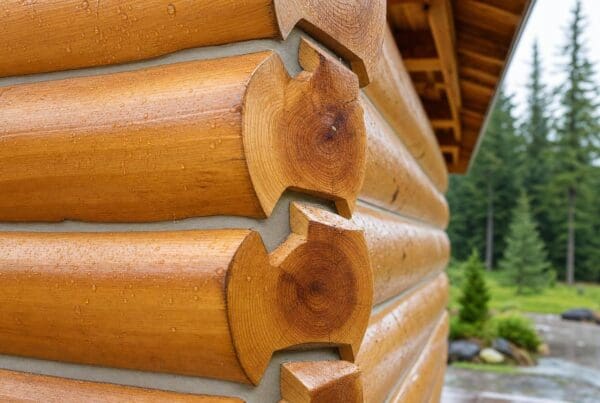
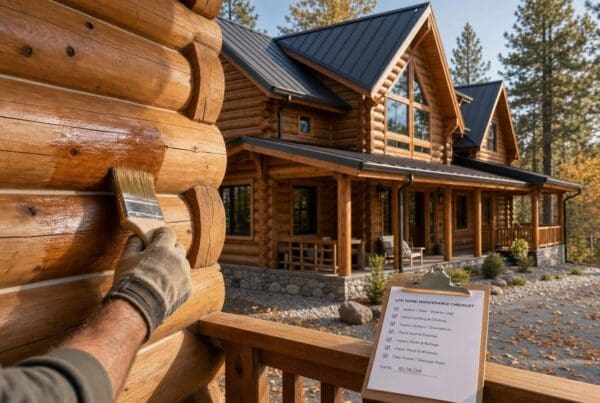
- Cedar Log Systems: Renewable and naturally carbon-storing, cedar offers durability, moisture resistance, and moderate insulation. Ideal for rustic designs.
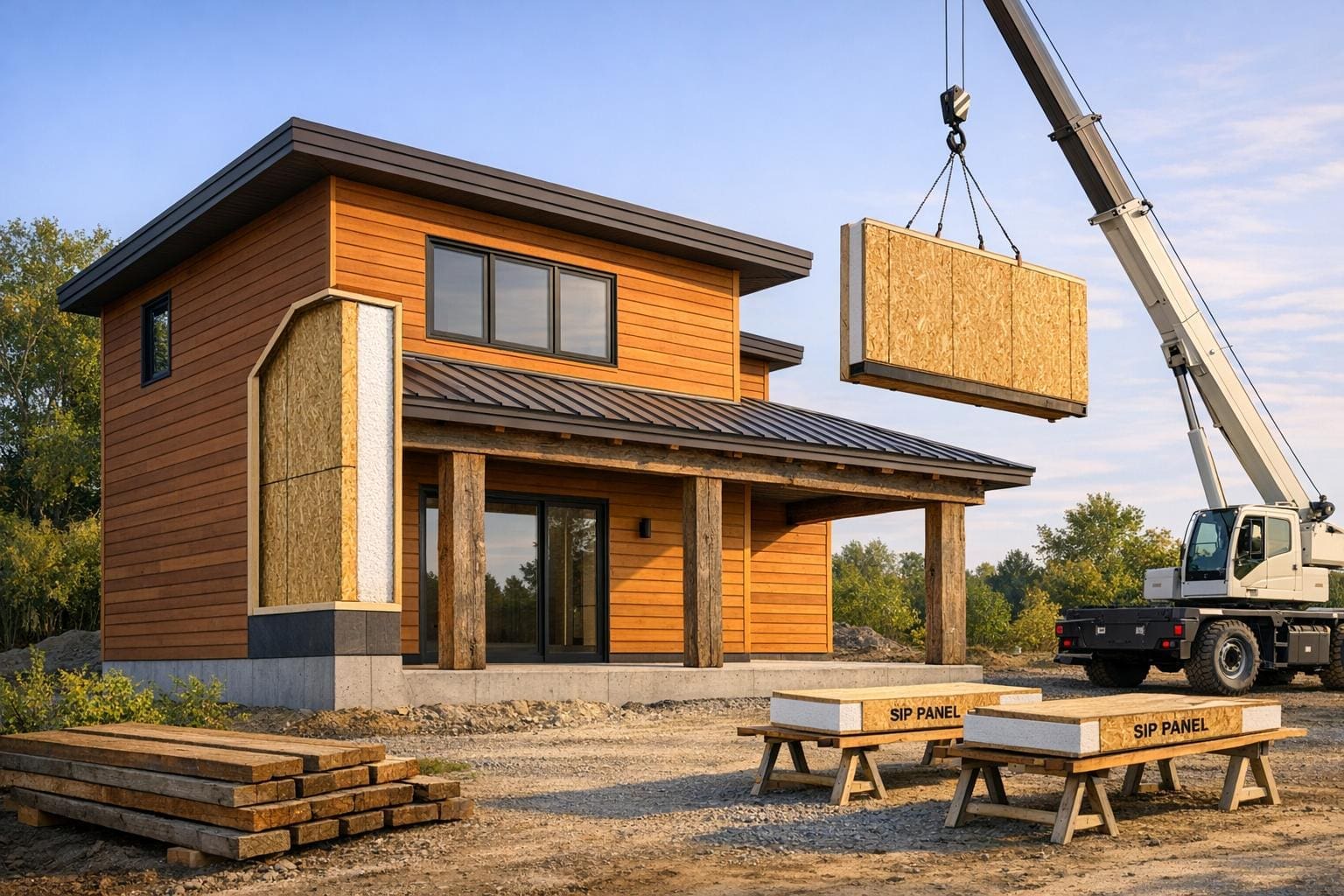
- Structural Insulated Panels (SIPs): Prefabricated panels with EPS or GPS foam cores provide airtight construction, cutting heating and cooling costs by up to 60%.
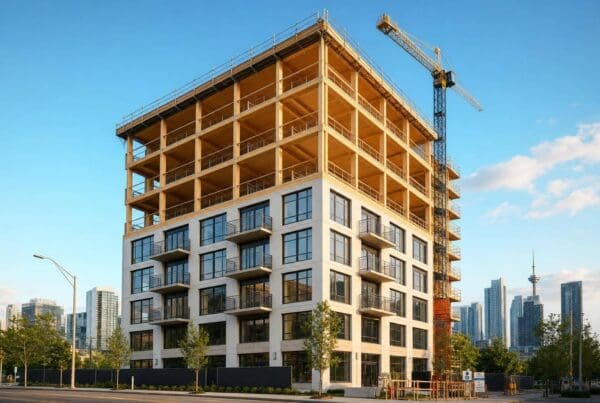
- Panelized Framing Systems: Precision-built in factories, these reduce waste and speed up construction while offering design flexibility.
- Reclaimed & Recycled Materials: Salvaged wood, recycled steel, and crushed concrete reduce resource use and add unique character to homes.
Quick Comparison
| Material | Key Benefits | Insulation Performance | Durability | Design Suitability |
|---|---|---|---|---|
| Cedar Log Systems | Carbon storage, natural durability | Moderate | High | Rustic or natural aesthetics |
| SIPs with EPS or GPS Foam | Airtight, energy-efficient | Excellent | Very High | Modern, open layouts |
| Panelized Framing Systems | Reduced waste, faster construction | High | Very High | Customizable structures |
| Reclaimed & Recycled Materials | Low resource use, unique style | Variable | Very High | Custom or historic designs |
Each of these custom home building solutions has unique strengths. Combining materials can maximize performance and minimize the environmental impact of your home.
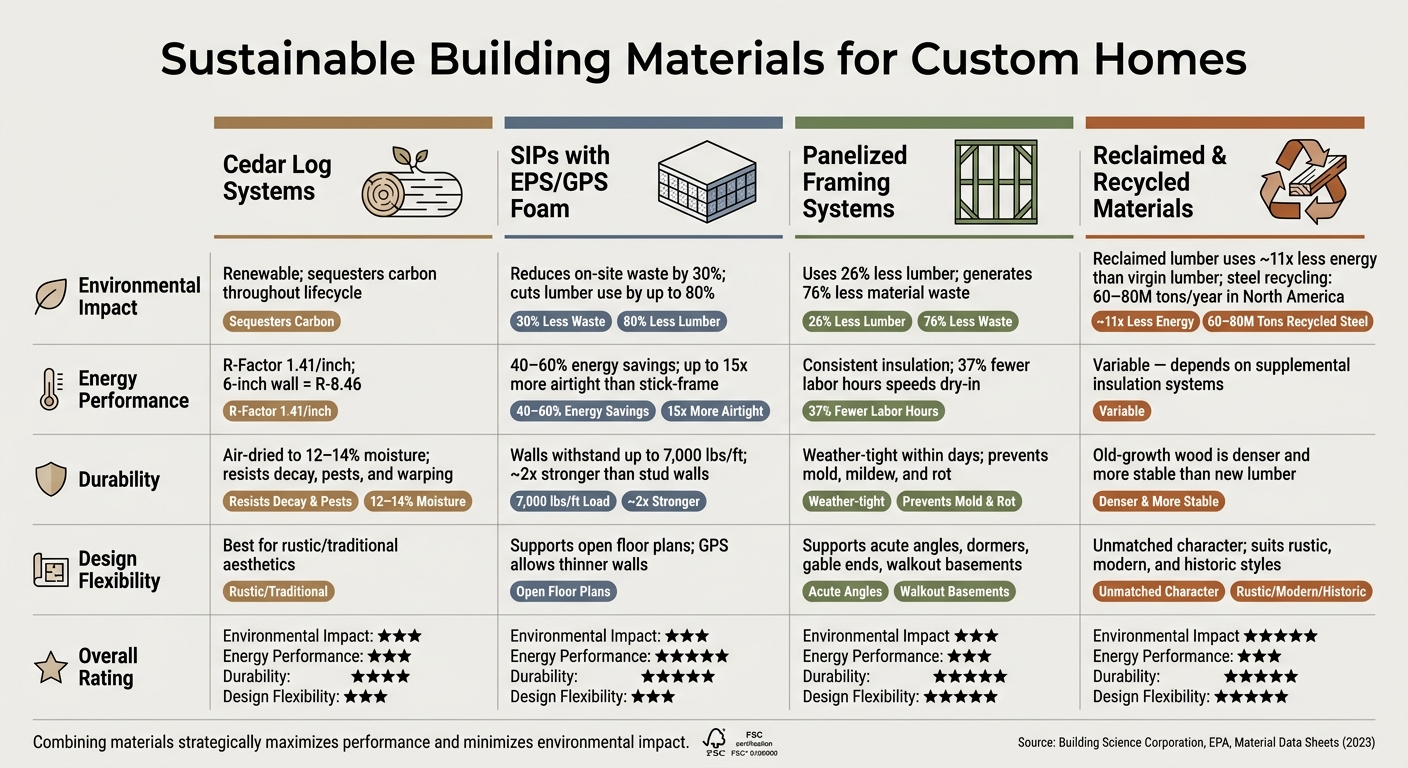
Sustainable Building Materials Compared: Cedar, SIPs, Panelized & Reclaimed
1. Cedar Log Systems
Cedar log systems offer a natural, eco-friendly option for custom home construction. Unlike concrete or steel – both of which are significant contributors to industrial emissions – wood has the unique ability to store carbon throughout its lifecycle. As the U.S. Green Building Council explains, "Wood stores carbon both while living and when used in a long-term product." [1] When cedar is sourced from certified, sustainably managed forests, it becomes an environmentally conscious building material.
Environmental Impact
Northern White Cedar stands out as a renewable resource, capable of being replanted as it’s harvested. This keeps its environmental impact minimal. Even after being milled and incorporated into your home, cedar continues to sequester carbon, adding long-term environmental benefits. Along with its eco-friendly qualities, cedar is known for its durability and low-maintenance requirements, making it a smart choice for sustainable building.
Durability and Maintenance
Cedar naturally resists moisture, decay, and pests, which reduces the need for extensive upkeep. Its low natural moisture content – air-dried to 12–14% before shipping – helps prevent warping and the formation of air gaps that can occur with less stable woods. This stability ensures a tighter, more consistent structure over time. Additionally, cedar’s structural integrity supports excellent thermal performance, which is a key factor in maintaining a comfortable home environment.
Energy Efficiency
Cedar’s technical properties contribute to energy conservation and overall home performance. For example, Northern White Cedar has an R-Factor of 1.41 per inch, outperforming pine, which has an R-Factor of 1.12 per inch [4]. A 6-inch cedar log wall achieves an average R-Factor of 8.46, compared to 7.26 for a similar pine wall [4]. To meet modern energy standards without sacrificing the charm of a log home, structural insulated panels (SIP) can be added to areas like roofs, gable ends, or walkout basements.
Design Flexibility
Cedar’s natural warmth and character make it an excellent choice for a variety of architectural styles, from rustic mountain cabins to sophisticated custom designs. At Big Twig Homes, cedar log home and SIP packages are supplied by Moosehead Cedar Log Homes, ensuring high-quality materials with traceable origins from responsibly managed forests. Inside the home, cedar paneling or wainscoting can enhance both the visual appeal and insulating properties, extending its benefits throughout the living space.
sbb-itb-1086e16
2. Structural Insulated Panels (SIPs) with EPS or GPS Foam
Structural Insulated Panels (SIPs) are prefabricated building components made with a rigid foam core – either Expanded Polystyrene (EPS) or Graphite Polystyrene (GPS) – sandwiched between two layers of oriented strand board (OSB). At Big Twig Homes, SIP packages are sourced from EPS Building Systems, which ensures the foam cores are 100% recyclable, free from ozone-depleting substances, and treated with safe, EPA-approved mineral additives to keep pests at bay [5][6].
Environmental Impact
One of the standout benefits of SIPs is their ability to minimize waste and resource use. These factory-cut panels reduce on-site waste by 30% and cut back on lumber needs by as much as 80%. Additionally, producing SIPs requires far less energy compared to traditional materials like steel, concrete, or masonry [6][7]. As noted by EPS Building Systems:
"The energy that powers homes and commercial buildings is responsible for a large portion of greenhouse gasses emitted into the atmosphere. By reducing the amount of energy used in buildings… homeowners can contribute to a clean environment for the future." [5]
Energy Efficiency
SIPs are known for creating extremely airtight building envelopes – up to 15 times tighter than traditional stick-frame construction. This tightness results in energy savings of 40% to 60%, often cutting heating and cooling costs by over half [5][6].
The foam core plays a significant role in this efficiency. EPS provides excellent insulation, while GPS offers an upgrade with its high-purity graphite particles, which reflect radiant heat. GPS panels deliver 20% higher R-values than standard EPS at the same thickness and perform even better as outdoor temperatures drop [9].
Because SIP homes are so efficient, HVAC systems need to be carefully sized to avoid issues like short cycling, which can lead to improper dehumidification [5]. To ensure healthy indoor air quality, a controlled ventilation system – such as a Heat Recovery Ventilator (HRV) – is essential [5][8].
Durability and Maintenance
SIPs are not just energy-efficient – they’re also incredibly strong. Their construction mimics the design of a steel I-beam, with the OSB layers acting as flanges and the foam core serving as the web. This gives SIPs impressive rigidity. SIP walls can withstand up to 7,000 pounds per foot, making them about twice as strong as conventional stud walls [5]. The result? Homes built with SIPs are straighter, more dimensionally stable, and less prone to common issues like settling or air leaks over time.
Design Flexibility
In addition to their strength and efficiency, SIPs offer great versatility in design. They can be precision-cut in the factory to accommodate nearly any architectural plan, including pre-cut openings and built-in electrical chases, which help minimize on-site adjustments [5][10]. Their strength also supports open floor plans, eliminating the need for extra load-bearing walls or posts [11].
GPS panels, with their superior thermal performance, allow for thinner wall assemblies while still meeting energy efficiency standards, giving architects more freedom to explore creative layouts without compromising on performance [10].
"SIPs can be engineered to fit any design, granting architects flexibility without sacrificing structural integrity." – Structural Insulated Panel Association [7]
3. Panelized Framing Systems
Panelized framing systems take a factory-based approach to building homes. Using Computer-Aided Design (CAD), wall panels, roof sections, and floor systems are crafted with precision in a controlled environment, then shipped to the construction site for assembly. At Big Twig Homes, these packages include prefabricated walls, roofs, and floors tailored to your specific home design – whether it’s a cozy mountain retreat or a primary residence. This method not only ensures accuracy but also offers meaningful environmental advantages.
Environmental Impact
By constructing panels in a factory setting, material waste is drastically reduced. Compared to traditional onsite framing, panelized construction uses 26% less lumber and generates 76% less material waste [14]. The controlled environment minimizes overordering and eliminates delays caused by weather, both of which contribute to waste in conventional methods. Thanks to these efficiencies, the ICC 700 National Green Building Standard recognizes panelized construction for reducing waste and limiting site disruption [13].
Energy Efficiency
The factory process ensures consistent insulation across every panel, avoiding the gaps or voids often seen with manual onsite installation. This tighter building envelope improves energy performance, helping homeowners save on heating and cooling costs. Additionally, panelized systems require 37% fewer labor hours compared to traditional methods [14]. This efficiency speeds up the "dry-in" phase, shielding the home’s interior from early exposure to moisture.
Durability and Maintenance
Panelized homes become weather-tight within days of assembly, protecting structural components from prolonged exposure to rain and humidity. This early protection helps prevent mold, mildew, and rot – common issues in traditional stick-built homes [13][14]. Beyond durability, panelized construction supports flexible designs, making it an appealing option for personalized layouts.
Design Flexibility
Panelized systems are highly adaptable, thanks to advanced CAD software. Designers can create panels for various layouts, including acute wall angles, custom dormers, gable ends, and walkout basements [12][14]. This flexibility allows homeowners to customize the structural framework while leaving interior finishes entirely up to personal choice.
Unlike modular prefab homes – which arrive 70–90% complete and limit customization – panelized systems provide the structural shell only. This allows homeowners to fully personalize interior layouts, finishes, and materials [12].
4. Reclaimed and Recycled Materials
Reclaimed and recycled materials – like salvaged wood beams, recycled steel, and crushed concrete – are gaining traction in custom home construction. By using these materials, you’re giving them a second life, turning what might have been waste into something functional and beautiful. This approach pairs well with other sustainable options, transforming existing resources into unique design features.
Environmental Impact
The energy savings from using reclaimed materials are hard to ignore. Richard Bergman, PhD, a Research Wood Scientist with the U.S. Forest Service, highlights this in his research:
"Results from this life-cycle inventory showed that cumulative energy consumed in producing virgin compared to reclaimed framing lumber and wood flooring was about 11 and 13 times greater, respectively. Global Warming Potential was about 3 and 5 times greater, respectively." [15]
On top of that, North America recycles 60–80 million tons of steel scrap annually, which reduces the need for extracting new resources [2]. Choosing locally sourced reclaimed materials can cut down transportation emissions and even help lower costs.
Durability and Maintenance
Reclaimed materials aren’t just eco-friendly – they’re often built to last. For example, reclaimed wood is usually stronger than new lumber because it comes from old-growth trees that have naturally dried over decades. This makes it denser and more stable, which is especially handy in regions with fluctuating humidity levels where new wood might warp or crack [16].
That said, reclaimed materials do require some prep work. Before installation, older wood should be checked for lead paint, asbestos, pests, or hidden nails. Once installed, maintenance is straightforward – occasional waxing and avoiding harsh cleaners are typically enough to keep it looking great.
Design Flexibility
Reclaimed materials also bring a one-of-a-kind aesthetic to your home. Their texture and character can’t be matched by new materials. Reclaimed wood, for instance, can fit seamlessly into both rustic mountain cabins and sleek, modern spaces. Recycled glass works beautifully for countertops or tiles, while reclaimed structural timbers like Douglas fir or old-growth southern yellow pine make for stunning exposed beams. The trick is to plan early – sourcing specific reclaimed pieces can take time, so factoring this into your design process ensures you get the best options without scrambling at the last minute.
Pros and Cons of Each Material
Choosing the right building material for your custom home involves weighing several factors like climate, budget, design vision, and how much upkeep you’re ready to take on. Below is a quick comparison of the environmental impact, durability, energy performance, and design flexibility for each material discussed.
| Material | Environmental Impact | Durability | Energy Performance | Design Flexibility |
|---|---|---|---|---|
| Cedar Log Systems | High – renewable and stores carbon effectively | High – lasts long with proper care | Moderate – decent thermal mass but benefits from extra insulation | Moderate – ideal for rustic or traditional aesthetics |
| SIPs with EPS or GPS Foam | High – energy efficiency lowers long-term carbon output | High – resists moisture when sealed correctly | Excellent – tight air sealing slashes heating and cooling needs | Moderate – fits various styles but less suited for intricate designs |
| Panelized Framing Systems | High – uses precision-cut engineered wood with recycled content | Very High – designed for consistent, reliable performance | High – works well with energy-efficient systems | High – versatile for modern, custom, or prefab designs |
| Reclaimed & Recycled Materials | Excellent – avoids new resource extraction entirely | Very High – aged wood is more stable than new lumber | Variable – depends on added insulation and system integration | High – unmatched character for custom or historic designs |
This table highlights the key differences to help you make an informed decision for a sustainable home build. Each option has its strengths and trade-offs, so consider your specific goals when selecting materials.
Key Takeaways:
- SIPs with EPS or GPS foam dominate in energy efficiency. Their airtight construction significantly cuts heating and cooling costs over the home’s lifetime.
- Panelized framing systems shine in precision and speed. For instance, the Escobedo Group‘s DARIO system, fabricated in Austin, Texas, was installed in rural Colorado in just five days [17]. This fast setup minimizes on-site disruption and shortens the overall timeline.
- Cedar log systems bring a timeless, natural look rooted in traditional craftsmanship. They also sequester carbon, but their design flexibility is more limited compared to panelized or reclaimed materials [17].
- Reclaimed materials stand out for their low environmental footprint and unique character. However, energy efficiency depends on how well supplemental systems are integrated.
Each material offers a unique mix of sustainability, performance, and design possibilities. Understanding these trade-offs will help you pick the best option for your custom home’s needs.
Conclusion
There’s no one-size-fits-all material for building sustainable homes, but combining materials strategically can make a world of difference. For example, SIPs with EPS or GPS foam create a tight, energy-efficient building envelope, cedar log systems bring natural durability and charm, and reclaimed wood adds character while reducing waste. These combinations not only boost performance but also help lower the environmental impact of construction.
The construction industry is a major contributor to global greenhouse gas emissions, which makes thoughtful design and material choices critical. Taking an envelope-first approach – focusing on insulation, air sealing, and high-performance windows before worrying about finishes – can have the biggest impact on energy efficiency and environmental sustainability [3].
It’s also important to tailor materials to the local climate. In colder regions, triple-pane windows and airtight SIP systems are ideal for retaining heat. In warmer, arid areas, materials with higher thermal mass can help regulate indoor temperatures and cut down on HVAC usage. When choosing wood products, look for FSC (Forest Stewardship Council) certification to ensure responsible sourcing.
"When the building envelope is designed properly and paired with healthy, durable materials, sustainability becomes a natural outcome of good building practices." – Thomas Built Homes [3]
FAQs
Which sustainable material is best for my climate?
In choosing the best materials for a sustainable home, your local climate plays a key role. For instance, if you live in a humid or coastal area, cedar wood stands out. It naturally resists moisture, decay, and pests, making it a durable option in such conditions.
For energy efficiency across a range of climates, SIP panels with EPS foam are a great choice. These panels offer excellent insulation, helping to keep indoor temperatures consistent and reducing energy use.
Ultimately, it’s important to consider your specific climate zone. Consulting local experts can help you identify materials that balance durability and sustainability for your custom home.
Can I combine SIPs, cedar, and reclaimed materials in one home?
Yes, you can blend SIPs (Structural Insulated Panels), cedar, and reclaimed materials in a single home. These materials complement each other beautifully in sustainable construction, offering benefits like improved energy efficiency, reduced environmental impact, and long-lasting durability. This combination also lets you design an eco-conscious home with distinctive, personalized touches.
What should I inspect for before using reclaimed wood?
Before working with reclaimed wood, it’s important to carefully inspect each piece to make sure it’s safe and in good condition. Start by checking for any sharp objects or metal pieces that might be embedded in the wood – using a metal detector can make this process easier. Look closely for signs of rot, pest infestations, or structural damage. Finally, verify that the wood’s quality and condition align with the requirements of your specific project. These precautions ensure the wood is both safe to use and durable enough for the task at hand.