
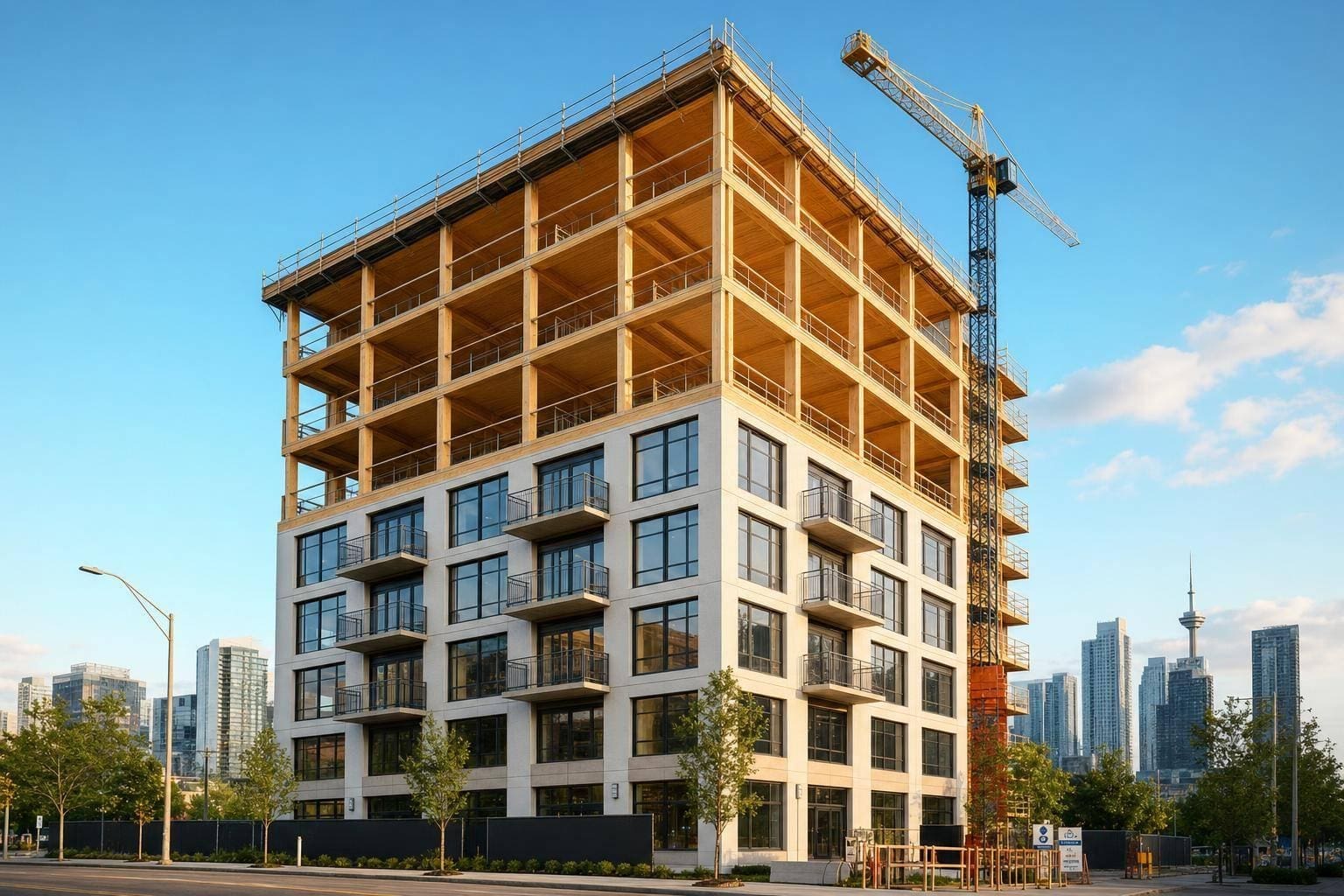
A 2023 change to the Ontario Building Code has helped accelerate the use of wood in mid-rise construction, with about half of the province’s five- and six-storey buildings now being built with wood, according to WoodWorks Ontario.
Three years ago, developers building mid-rise wood-frame projects in Ontario were still required to construct stairwells with non-combustible material. The Canadian Wood Council said that added cost and complexity and contributed to lower uptake of wood-frame construction. After the requirement was removed in 2023, full buildings could be built with wood.
"Now, in our market, we’re sitting at around 50 per cent of five- and six-storey buildings being built out of wood construction, so a great jump", Quiquero said during a June 4 online webinar.
"We’ve still got a long way to go. In British Columbia, I think it’s greater than 80 per cent of this market is built out of wood, so lots of room and opportunity to keep educating our market here about this really cost-effective method of building housing, especially."
Hailey Quiquero, senior manager with the WoodWorks Ontario program, an initiative of the Canadian Wood Council, said the strongest use of mid-rise wood-frame construction in Ontario is currently in residential development.
Under the code, wood-frame construction is allowed in five- and six-storey Group C major occupancy buildings, including apartments, hotels, motels, student residencies and dormitories, as well as Group D buildings such as banks, offices, and medical or dental offices.
"This type of construction is one of the most cost-effective ways of building housing in our market right now", she said.
"It’s very fast and lightweight, especially if you make use of panelization, and due to the fact that you can now do combustible stair shafts and exit shafts, this really just makes it extremely cost-effective and easy to build."
Prefabrication and engineered wood
Quiquero said panelization – building wood wall or floor panels off site – allows parallel construction, with factory production happening while site work continues. She said the method can improve quality, reduce rework and waste, shorten construction schedules, lower neighborhood disruption, and improve labor safety.
She also outlined several forms of structural composite lumber now being used in these projects. Laminated veneer lumber is made from thin wood veneers glued and pressed in the same direction. Laminated strand timber uses wood shavings cut into strands and compressed into dense wood fiber. Parallel strand timber follows a similar process, but the strands are aligned parallel to each other and carry the highest strength rating.
"In using structural composite lumber, "you’re not limited to the length of the tree, so you can get unlimited length in production of these studs or beams, whatever you’re using them for", Quiquero said.
"It’s a more effective use of the wood fibre in the trees as well, which is nice."
Quiquero said structural composite lumber has lower moisture content than standard lumber, which makes it more dimensionally stable, and added that it offers increased fire resistance.
"Of course, they do come with a bit of a cost premium to lumber, so it’s worth exploring whether or not it’s worth investing in those engineered products in certain applications inside these buildings", she said.
sbb-itb-1086e16
Kitchener projects highlight timeline gains
Two Kitchener developments were cited as examples of how wood construction and prefabrication are being used in practice.
The Evoke project, designed by Zeidler Architecture and developed by Traine Construction & Development, is planned as four six-storey buildings with up to 310 one- and two-bedroom apartments. The development uses light wood-frame design and prefabricated wood panels from P3 Panel Company, with stud walls and engineered floor systems assembled using wall and flooring panels.
"So … you’re really able to maximize the speed on site", she said.
Another Kitchener project, Franklin Flats, was designed by ABA Architects and MT Engineering & Design and built by Maxwell Building Consultants. It includes four buildings with one- and two-bedroom units.
For the first building, the developers used concrete shafts. The other three were built entirely with wood, combining light wood framing with mass timber floors and cores. Quiquero said the use of mass timber cores allowed crews to install one floor per day and cut 48 total working days from the schedule.
Quiquero called this "super efficient, schedule-wise."
"They are able to get these buildings from breaking ground to occupancy in about 11 months", Quiquero said.
"So that’s just such a super impressive construction timeline, and that’s been true in a lot of these types of buildings that we’ve been seeing using some kind of panelization or prefabrication approach."